啰 (luō) means "talkative; chatter" in Chinese. It has 11 strokes with the radical 口.
Rated 3.9/5 in difficulty (challenging).
Appears in 3+ common words including 啰唆 (luō suō), 啰里啰唆 (luō lǐ luō suō), 啰音 (luō yīn).
Due to its 11 strokes, Hanzi Writer's error detection shows 啰 requires focused practice — most learners need 10+ attempts for consistent accuracy.
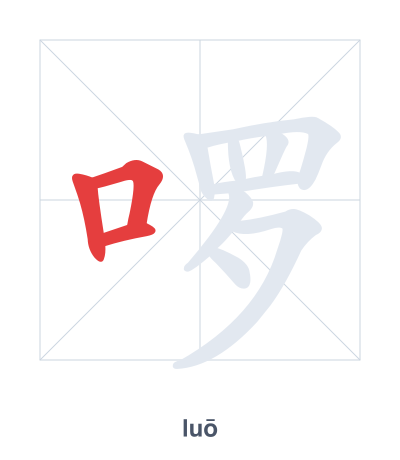
Open Hanzi Writer to see the animated stroke order and practice writing 啰 with real-time feedback.
The character 啰 (luō) is written with 11 strokes. Follow the standard Chinese stroke order: top to bottom, left to right, outside before inside. The radical 口 is one of its key components.
Practice the correct stroke order with the Hanzi Writer app to see animated stroke-by-stroke guidance with real-time feedback.
啰 means talkative; chatter.
啰 is a compound character combining the mouth radical (口, indicating speech) with 罗 (luó, meaning 'net' or 'to collect'), suggesting a mouth that 'collects' or nets many words—hence talkative or chatty.
💡 Memory Tip: Imagine a mouth (口) that acts like a net (罗), catching every word around and never stopping talking.
别再啰唆了。
bié zài luō suō le
Stop rambling.
他说话啰里啰唆。
tā shuō huà luō lǐ luō suō
He is very wordy when he speaks.
肺部有啰音。
fèi bù yǒu luō yīn
There are rales (crackling sounds) in the lungs.
Open Hanzi Writer to see the animated stroke order and practice writing 啰 with real-time feedback.
✨ Animated stroke order · Handwriting recognition · HSK-graded practice · Free to use
啰 is made of the radical 口 (mouth) on the left and the phonetic component 罗 (luó) on the right. The 口 shows the meaning involves speech or the mouth, and together with the sound 罗 it creates the idea of being talkative or chattering.