唆 (suō) means "To instigate or incite." in Chinese. It has 10 strokes with the radical 口.
Rated 4.2/5 in difficulty (advanced).
Appears in 3+ common words including 教唆 (jiào suō), 唆使 (suō shǐ), 挑唆 (tiǎo suō).
Due to its 10 strokes, Hanzi Writer's error detection shows 唆 requires focused practice — most learners need 10+ attempts for consistent accuracy.
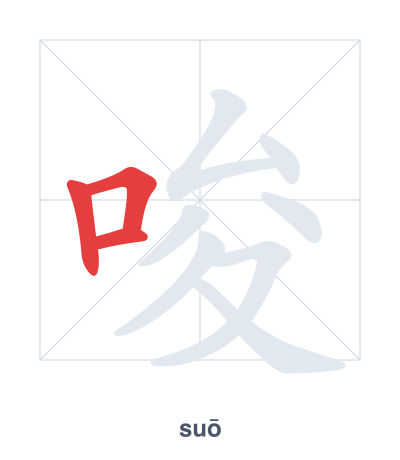
Open Hanzi Writer to see the animated stroke order and practice writing 唆 with real-time feedback.
The character 唆 (suō) is written with 10 strokes. Follow the standard Chinese stroke order: top to bottom, left to right, outside before inside. The radical 口 is one of its key components.
Practice the correct stroke order with the Hanzi Writer app to see animated stroke-by-stroke guidance with real-time feedback.
唆 means To instigate or incite..
唆 is a compound character with the mouth radical (口) indicating speech, and the phonetic component 夋 (suō), which originally depicted a figure moving or advancing. Together, the character suggests using words to provoke or urge someone into action—literally 'mouth that sets things in motion.'
💡 Memory Tip: Imagine a mouth (口) whispering into the ear of a person (夋 resembles a figure with legs) to go start trouble—instigating them to move.
不要教唆别人做坏事。
bú yào jiào suō bié rén zuò huài shì
Don't instigate others to do bad things.
是谁唆使你这么做的?
shì shuí suō shǐ nǐ zhè me zuò de
Who instigated you to do this?
他喜欢挑唆是非。
tā xǐ huān tiǎo suō shì fēi
He likes to stir up trouble.
Open Hanzi Writer to see the animated stroke order and practice writing 唆 with real-time feedback.
✨ Animated stroke order · Handwriting recognition · HSK-graded practice · Free to use
The character 唆 is composed of the radical 口 (mouth) on the left, and the component 夋 on the right. The 口 radical suggests that the action involves speaking or using words. The right part 夋 provides a phonetic clue for the pronunciation suō, and together they create the idea of using speech to urge someone to do something, often negative.