篓 (lǒu) means "basket or hamper" in Chinese. It has 15 strokes with the radical 竹.
Rated 4.2/5 in difficulty (advanced).
Appears in 3+ common words including 纸篓 (zhǐ lǒu), 背篓 (bēi lǒu), 鱼篓 (yú lǒu).
Due to its 15 strokes, Hanzi Writer's error detection shows 篓 requires focused practice — most learners need 10+ attempts for consistent accuracy.
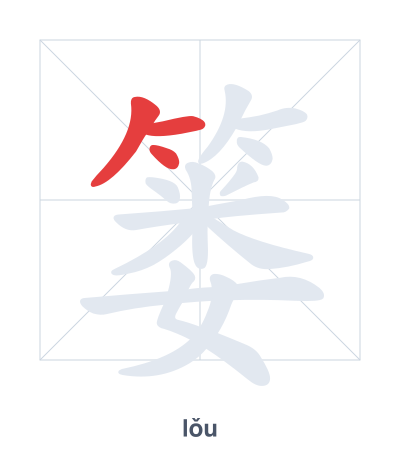
Open Hanzi Writer to see the animated stroke order and practice writing 篓 with real-time feedback.
The character 篓 (lǒu) is written with 15 strokes. Follow the standard Chinese stroke order: top to bottom, left to right, outside before inside. The radical 竹 is one of its key components.
Practice the correct stroke order with the Hanzi Writer app to see animated stroke-by-stroke guidance with real-time feedback.
篓 means basket or hamper.
篓 is a compound character. The top part 竹 (bamboo) signifies the material, while the bottom part 娄 (lóu) adds a phonetic hint and also suggests gathering or stacking, together forming a basket woven from bamboo for holding collected items.
💡 Memory Tip: Imagine a bamboo (竹) basket shaped like a 娄 (a woman with a basket on her head) gathering fruits.
纸篓在桌子下。
zhǐ lǒu zài zhuō zi xià
The wastepaper basket is under the table.
他背着一个背篓。
tā bèi zhe yí gè bēi lǒu
He is carrying a back basket.
鱼篓里有很多鱼。
yú lǒu lǐ yǒu hěn duō yú
There are many fish in the fish basket.
Open Hanzi Writer to see the animated stroke order and practice writing 篓 with real-time feedback.
✨ Animated stroke order · Handwriting recognition · HSK-graded practice · Free to use
篓 is made of the radical 竹 (bamboo) on top and the phonetic component 娄 (lóu) below. Since baskets are often woven from bamboo, the bamboo radical directly indicates the material, and 娄 provides the pronunciation.