筠 (yún) means "bamboo skin; (literary) bamboo" in Chinese. It has 13 strokes with the radical 竹.
Rated 4.2/5 in difficulty (advanced).
Appears in 3+ common words including 筠连 (yún lián), 筠溪 (yún xī), 筠席 (yún xí).
Due to its 13 strokes, Hanzi Writer's error detection shows 筠 requires focused practice — most learners need 10+ attempts for consistent accuracy.
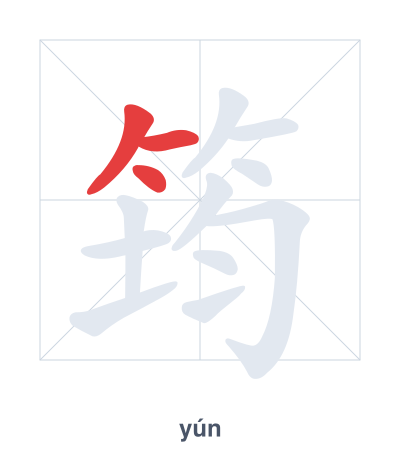
Open Hanzi Writer to see the animated stroke order and practice writing 筠 with real-time feedback.
The character 筠 (yún) is written with 13 strokes. Follow the standard Chinese stroke order: top to bottom, left to right, outside before inside. The radical 竹 is one of its key components.
Practice the correct stroke order with the Hanzi Writer app to see animated stroke-by-stroke guidance with real-time feedback.
筠 means bamboo skin; (literary) bamboo.
筠 combines the bamboo radical 竹 with the phonetic component 均 (yún, meaning 'equal' or 'uniform'). This suggests the smooth, even texture of bamboo skin, which is the character's literal meaning, and it later extended to refer to bamboo itself in literary contexts.
💡 Memory Tip: Picture a bamboo stalk (竹) with its skin so uniformly smooth (均) that it reflects like a mirror.
他去了筠连县。
tā qù le yún lián xiàn
He went to Junlian County.
筠溪的水很清。
yún xī de shuǐ hěn qīng
The water in Yunxi is very clear.
这张筠席很凉快。
zhè zhāng yún xí hěn liáng kuài
This fine bamboo mat is very cool.
Open Hanzi Writer to see the animated stroke order and practice writing 筠 with real-time feedback.
✨ Animated stroke order · Handwriting recognition · HSK-graded practice · Free to use
The character 筠 combines the radical 竹 (bamboo) on top with the phonetic component 均 (jūn, meaning even or balanced) below. The top part shows that the character is related to bamboo, while the bottom part hints at its pronunciation, though the tones differ. Together, they form the meaning of bamboo skin or literary bamboo.