筢 (pá) means "bamboo rake" in Chinese. It has 13 strokes with the radical 竹.
Rated 4.2/5 in difficulty (advanced).
Appears in 3+ common words including 筢子 (pá zi), 竹筢 (zhú pá), 筢草 (pá cǎo).
Due to its 13 strokes, Hanzi Writer's error detection shows 筢 requires focused practice — most learners need 10+ attempts for consistent accuracy.
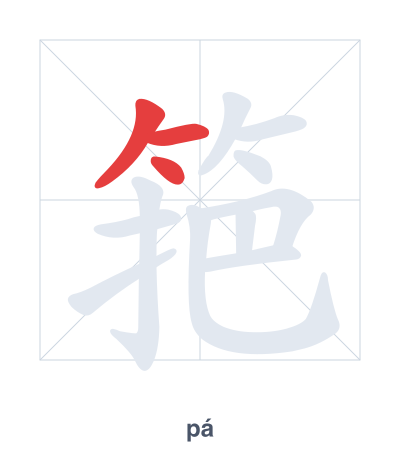
Open Hanzi Writer to see the animated stroke order and practice writing 筢 with real-time feedback.
The character 筢 (pá) is written with 13 strokes. Follow the standard Chinese stroke order: top to bottom, left to right, outside before inside. The radical 竹 is one of its key components.
Practice the correct stroke order with the Hanzi Writer app to see animated stroke-by-stroke guidance with real-time feedback.
筢 means bamboo rake.
筢 is a phono-semantic compound: the radical 竹 (bamboo) indicates the material, and 巴 (pā) provides the sound while also suggesting the action of raking or gathering. Ancient rakes were often made of bamboo, with curved teeth for pulling leaves or hay, and the top part 巴 visually resembles a hand gripping the handle.
💡 Memory Tip: Picture a bamboo rake (竹) with its curved teeth forming the shape of 巴, like a snake slithering along the ground to scoop up a pile of leaves.
他在用筢子。
tā zài yòng pá zi
He is using a rake.
这是一个竹筢。
zhè shì yí gè zhú pá
This is a bamboo rake.
他在院里筢草。
tā zài yuàn lǐ pá cǎo
He is raking grass in the yard.
Open Hanzi Writer to see the animated stroke order and practice writing 筢 with real-time feedback.
✨ Animated stroke order · Handwriting recognition · HSK-graded practice · Free to use
筢 is made of the radical 竹 (bamboo) on top and the character 耙 (pá, meaning "rake") below. The bamboo part shows the material, while 耙 indicates the tool's function, so together they mean "bamboo rake."