癃 (lóng) means "urinary retention or infirmity" in Chinese. It has 16 strokes with the radical 疒.
Rated 4.2/5 in difficulty (advanced).
Appears in 3+ common words including 癃闭 (lóng bì), 癃疾 (lóng jí), 癃症 (lóng zhèng).
Due to its 16 strokes, Hanzi Writer's error detection shows 癃 requires focused practice — most learners need 10+ attempts for consistent accuracy.
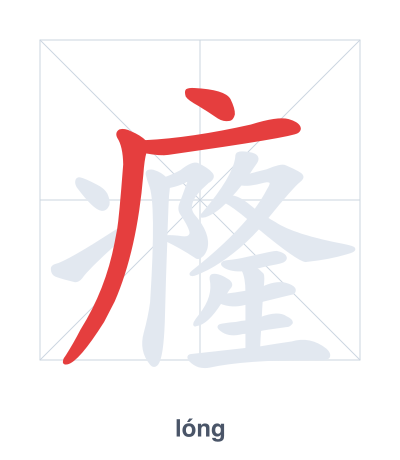
Open Hanzi Writer to see the animated stroke order and practice writing 癃 with real-time feedback.
The character 癃 (lóng) is written with 16 strokes. Follow the standard Chinese stroke order: top to bottom, left to right, outside before inside. The radical 疒 is one of its key components.
Practice the correct stroke order with the Hanzi Writer app to see animated stroke-by-stroke guidance with real-time feedback.
癃 means urinary retention or infirmity.
癃 is a phono-semantic compound: the radical 疒 (sickness) indicates it relates to illness, while 隆 (lóng) provides the pronunciation. The character originally described a condition of urinary retention or general infirmity, linking the idea of a 'swollen' or 'blocked' state (as in the character 隆's connotation of rising or bulging) with physical ailment.
💡 Memory Tip: Picture a person lying on a sickbed (疒) with a painfully swollen belly (the lower part of 隆 looking like a bulge) because they cannot urinate.
他患有癃闭症。
tā huàn yǒu lóng bì zhèng
He suffers from urinary retention.
老人有癃疾。
lǎo rén yǒu lóng jí
The elderly person has urinary problems.
这种癃症很痛苦。
zhè zhǒng lóng zhèng hěn tòng kǔ
This urinary retention is very painful.
Open Hanzi Writer to see the animated stroke order and practice writing 癃 with real-time feedback.
✨ Animated stroke order · Handwriting recognition · HSK-graded practice · Free to use
癃 combines the radical 疒 (illness) with the phonetic component 隆 (lóng, meaning 'prosperous' or 'swollen'). The 疒 radical indicates a disease, while 隆 suggests the sensation of swelling or blockage, which fits the condition of urinary retention where the bladder feels full and obstructed.