陵 (líng) means "mausoleum or hill" in Chinese. It has 10 strokes with the radical 阝, and is HSK Level 7.
Rated 3.9/5 in difficulty (challenging).
Harder than 37% of HSK Level 7 characters.
Appears in 3+ common words including 丘陵 (qiū líng), 陵园 (líng yuán), 十三陵 (shí sān líng).
Due to its 10 strokes, Hanzi Writer's error detection shows 陵 requires focused practice — most learners need 10+ attempts for consistent accuracy.
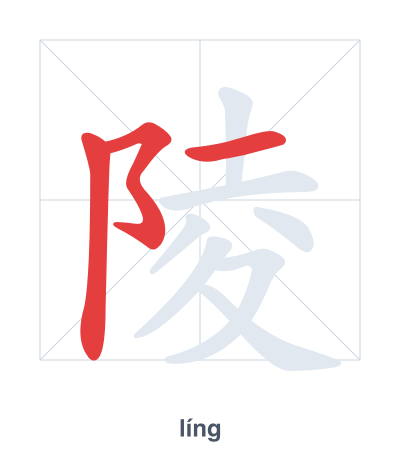
Open Hanzi Writer to see the animated stroke order and practice writing 陵 with real-time feedback.
The character 陵 (líng) is written with 10 strokes. Follow the standard Chinese stroke order: top to bottom, left to right, outside before inside. The radical 阝 is one of its key components.
Practice the correct stroke order with the Hanzi Writer app to see animated stroke-by-stroke guidance with real-time feedback.
陵 means mausoleum or hill.
As an HSK Level 7 character, 陵 is an intermediate-level character.
The left component 阝 (fù) is a variant of 阜, meaning a mound or hill, while the right component 夌 (líng) originally depicted a person climbing up a slope or stepping over obstacles. Together, they signify a tall, elevated mound, which can be a natural hill or an artificial tomb mound, hence the meanings 'hill' and 'mausoleum'.
💡 Memory Tip: Picture a hill (阝) with a person (夌's top part like 土 and 八) climbing over a mound to reach a grand tomb—this is the mausoleum on the hill.
南方有很多丘陵。
nán fāng yǒu hěn duō qiū líng
There are many hills in the south.
我们去参观陵园。
wǒ men qù cān guān líng yuán
We are going to visit the mausoleum park.
北京有明十三陵。
běi jīng yǒu míng shí sān líng
Beijing has the Ming Tombs.
Open Hanzi Writer to see the animated stroke order and practice writing 陵 with real-time feedback.
✨ Animated stroke order · Handwriting recognition · HSK-graded practice · Free to use
The left component is 阝, which means hill or mound. The right component is 夌, meaning to climb or mound. Together they form the idea of a hill or burial mound, which is the origin of the meanings 'mausoleum' and 'hill'.