赁 (lìn) means "to rent; to hire" in Chinese. It has 10 strokes with the radical 贝, and is HSK Level 7.
Rated 4.2/5 in difficulty (advanced).
Harder than 90% of HSK Level 7 characters.
Appears in 3+ common words including 租赁 (zū lìn), 赁房 (lìn fáng), 出赁 (chū lìn).
Due to its 10 strokes, Hanzi Writer's error detection shows 赁 requires focused practice — most learners need 10+ attempts for consistent accuracy.
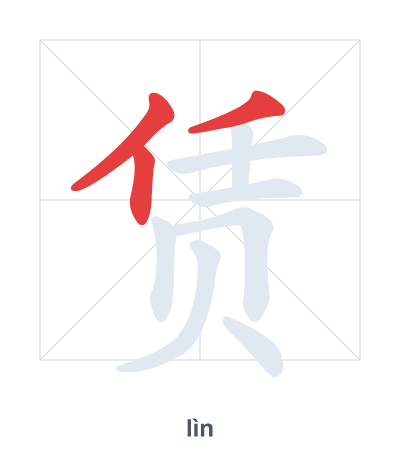
Open Hanzi Writer to see the animated stroke order and practice writing 赁 with real-time feedback.
The character 赁 (lìn) is written with 10 strokes. Follow the standard Chinese stroke order: top to bottom, left to right, outside before inside. The radical 贝 is one of its key components.
Practice the correct stroke order with the Hanzi Writer app to see animated stroke-by-stroke guidance with real-time feedback.
赁 means to rent; to hire.
As an HSK Level 7 character, 赁 is an intermediate-level character.
The character 赁 combines 贝 (shell, ancient money) as a semantic component to indicate a financial transaction, with 任 (responsibility) as a phonetic component that also suggests the idea of taking on a temporary obligation. Thus, renting or hiring involves paying money to assume the use or service of something for a period.
💡 Memory Tip: Picture a tenant (亻) handing over shells (贝) to a landlord, saying 'I'll take responsibility (任) for this place'—that's 赁 (rent).
公司租赁了一台电脑。
gōng sī zū lìn le yī tái diàn nǎo
The company leased a computer.
他在学校附近赁房住。
tā zài xué xiào fù jìn lìn fáng zhù
He is renting a room near the school.
这间店面准备出赁。
zhè jiān diàn miàn zhǔn bèi chū lìn
This storefront is ready to be leased.
Open Hanzi Writer to see the animated stroke order and practice writing 赁 with real-time feedback.
✨ Animated stroke order · Handwriting recognition · HSK-graded practice · Free to use
赁 is a left-right character. The left side is 贝 (shell, representing money), and the right side is 任 (meaning 'to appoint' or 'duty'). Together, they suggest paying money to hire someone or rent something.