Hanzi Writer

How to Write 踉 (liàng) — Meaning “to stumble; to stagger”

liàng 14 strokes Radical: 足

踉 (liàng) means "to stumble; to stagger" in Chinese. It has 14 strokes with the radical 足.

Rated 4.2/5 in difficulty (advanced).

Appears in 3+ common words including 踉跄 (liàng qiàng), 踉踉跄跄 (liàng liàng qiàng qiàng), 踉跄一步 (liàng qiàng yī bù).

Due to its 14 strokes, Hanzi Writer's error detection shows 踉 requires focused practice — most learners need 10+ attempts for consistent accuracy.
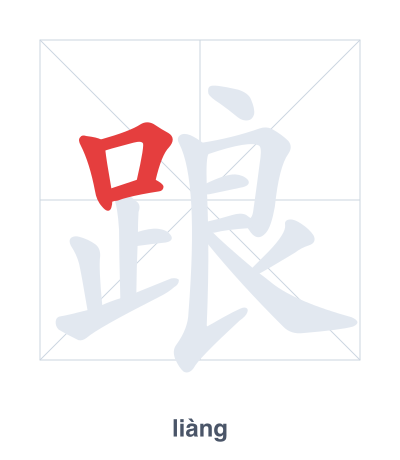
Stroke order practice for 踉 - liàng

Practice Writing 踉 (liàng)

Open Hanzi Writer to see the animated stroke order and practice writing 踉 with real-time feedback.

The character (liàng) is written with 14 strokes. Follow the standard Chinese stroke order: top to bottom, left to right, outside before inside. The radical is one of its key components.

Practice the correct stroke order with the Hanzi Writer app to see animated stroke-by-stroke guidance with real-time feedback.

means to stumble; to stagger.

Character
Pinyinliàng (liang)
Meaningto stumble; to stagger
Strokes14
Radical
Difficulty4.2/5

踉 is a phono-semantic compound where 足 (foot) indicates the meaning relates to walking, and 良 (liáng) provides the pronunciation. The character describes a stumbling, unsteady gait, as if the foot itself is unreliable.

💡 Memory Tip: Picture a foot (足) that is not good (良) at walking, so it keeps staggering and tripping over nothing.

liàng qiàng
to stagger; to stumble
liàng liàng qiàng qiàng
staggering; stumbling
liàng qiàng yī bù
to take a stumbling step

他走路有点踉跄。

tā zǒu lù yǒu diǎn liàng qiàng

He is walking a bit unsteadily.

他踉踉跄跄地跑来。

tā liàng liàng qiàng qiàng dì pǎo lái

He came running over, stumbling.

他脚下踉跄一步。

tā jiǎo xià liàng qiàng yī bù

He stumbled a step.

Character Pinyin Strokes Radical
(current) liàng 14
tāng 15
tái 12
12
Stroke order practice for 踉 - liàng

Practice Writing 踉 (liàng)

Open Hanzi Writer to see the animated stroke order and practice writing 踉 with real-time feedback.

✨ Animated stroke order · Handwriting recognition · HSK-graded practice · Free to use

Frequently Asked Questions about 踉

The character 踉 is a left-right structure. The left radical 足 means "foot," and the right part 良 (liáng) gives the sound while also suggesting a sense of "good" or "gentle" — together they imply a foot not moving steadily, like a gentle stumble.

Characters with Radical 足

Other 14-Stroke Characters