跆 (tái) means "to kick; to trample" in Chinese. It has 12 strokes with the radical 足.
Rated 4.2/5 in difficulty (advanced).
Appears in 3+ common words including 跆拳道 (tái quán dào), 跆拳 (tái quán), 跆拳道馆 (tái quán dào guǎn).
Due to its 12 strokes, Hanzi Writer's error detection shows 跆 requires focused practice — most learners need 10+ attempts for consistent accuracy.
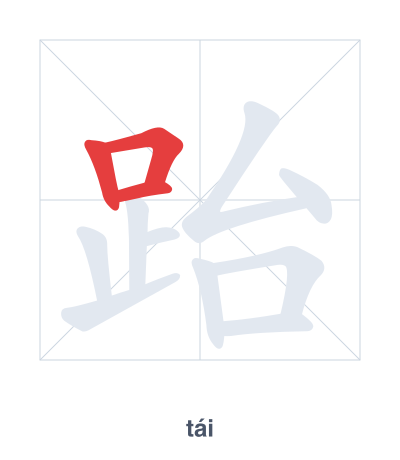
Open Hanzi Writer to see the animated stroke order and practice writing 跆 with real-time feedback.
The character 跆 (tái) is written with 12 strokes. Follow the standard Chinese stroke order: top to bottom, left to right, outside before inside. The radical 足 is one of its key components.
Practice the correct stroke order with the Hanzi Writer app to see animated stroke-by-stroke guidance with real-time feedback.
跆 means to kick; to trample.
跆 is a compound character with the radical 足 (foot) and the phonetic component 台 (platform). The foot on a platform suggests the action of stepping or kicking against a raised surface, hence 'to kick' or 'to trample'.
💡 Memory Tip: Picture a foot (足) kicking a heavy platform (台) that flies away—that's 跆: a powerful trample kick.
我在学习跆拳道。
wǒ zài xué xí tái quán dào
I am learning Taekwondo.
跆拳是一项运动。
tái quán shì yī xiàng yùn dòng
Taekwondo is a sport.
街角有一家跆拳道馆。
jiē jiǎo yǒu yī jiā tái quán dào guǎn
There is a Taekwondo gym on the street corner.
Open Hanzi Writer to see the animated stroke order and practice writing 跆 with real-time feedback.
✨ Animated stroke order · Handwriting recognition · HSK-graded practice · Free to use
跆 is made of the radical 足 (foot) on the left and the phonetic component 台 (tái) on the right. The 足 radical connects the character to actions done with the feet, like kicking or trampling. The right part 台 provides the pronunciation tái but does not directly add meaning.