跄 (qiāng/qiàng) means "to stagger; to stumble" in Chinese. It has 11 strokes with the radical 足.
Rated 4.2/5 in difficulty (advanced).
Appears in 3+ common words including 踉跄 (liàng qiàng), 跄步 (qiāng bù), 跄跄 (qiāng qiāng).
Due to its 11 strokes, Hanzi Writer's error detection shows 跄 requires focused practice — most learners need 10+ attempts for consistent accuracy.
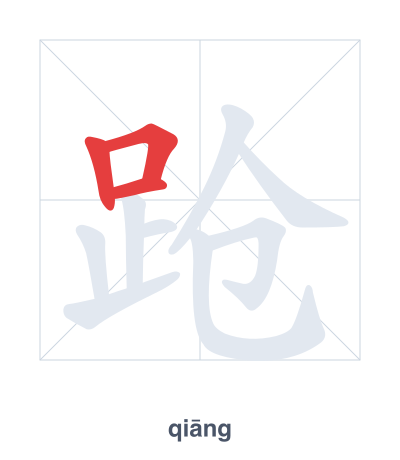
Open Hanzi Writer to see the animated stroke order and practice writing 跄 with real-time feedback.
The character 跄 (qiāng/qiàng) is written with 11 strokes. Follow the standard Chinese stroke order: top to bottom, left to right, outside before inside. The radical 足 is one of its key components.
Practice the correct stroke order with the Hanzi Writer app to see animated stroke-by-stroke guidance with real-time feedback.
跄 means to stagger; to stumble.
This is a polyphonic character with readings: qiāng, qiàng.
跄 (qiāng) is a compound character combining the radical 足 (foot) for walking-related actions with 仓 (cāng, granary) as a phonetic component. The meaning "to stagger" likely comes from the image of someone walking unsteadily while carrying a heavy load from a granary.
💡 Memory Tip: Picture a person with a sore foot (足) tripping and stumbling into a granary (仓), losing their balance.
他走路有些踉跄。
tā zǒu lù yǒu xiē liàng qiàng
He is walking a bit unsteadily.
他打了个跄步。
tā dǎ le gè qiāng bù
He took a stumbling step.
小孩走路跄跄的。
xiǎo hái zǒu lù qiāng qiāng de
The child is walking unsteadily.
Open Hanzi Writer to see the animated stroke order and practice writing 跄 with real-time feedback.
✨ Animated stroke order · Handwriting recognition · HSK-graded practice · Free to use
The character 跄 is composed of the radical 足 (foot) on the left and the phonetic component 仓 (cāng) on the right. The radical 足 indicates that the meaning is related to walking or foot movement, while 仓 suggests the sound qiāng. Together, they create the idea of unsteady foot movement, or staggering.