篱 (lí) means "fence" in Chinese. It has 16 strokes with the radical 竹.
Rated 4.2/5 in difficulty (advanced).
Appears in 3+ common words including 篱笆 (lí bā), 篱墙 (lí qiáng), 篱下 (lí xià).
Due to its 16 strokes, Hanzi Writer's error detection shows 篱 requires focused practice — most learners need 10+ attempts for consistent accuracy.
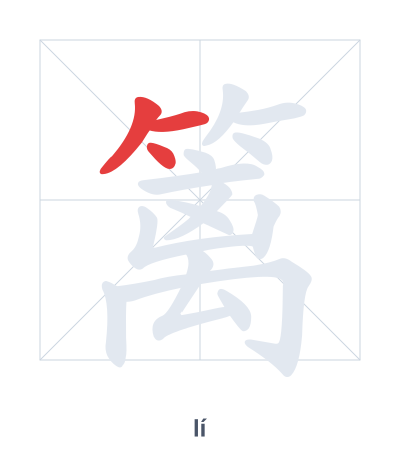
Open Hanzi Writer to see the animated stroke order and practice writing 篱 with real-time feedback.
The character 篱 (lí) is written with 16 strokes. Follow the standard Chinese stroke order: top to bottom, left to right, outside before inside. The radical 竹 is one of its key components.
Practice the correct stroke order with the Hanzi Writer app to see animated stroke-by-stroke guidance with real-time feedback.
篱 means fence.
篱 is a compound character: the top component 竹 (bamboo) shows the material, while the bottom 离 (meaning 'to leave' or 'to separate') hints at the fence's function of dividing spaces. Historically, such fences were woven from bamboo strips to mark boundaries or keep animals in.
💡 Memory Tip: Imagine a bamboo fence (竹) so tall that anyone trying to climb it must 'leave' (离) because they can't get over.
篱笆是木头做的。
lí bā shì mù tou zuò de
The fence is made of wood.
院子有一道篱墙。
yuàn zi yǒu yī dào lí qiáng
There is a fence around the yard.
菊花开在篱下。
jú huā kāi zài lí xià
Chrysanthemums bloom by the fence.
Open Hanzi Writer to see the animated stroke order and practice writing 篱 with real-time feedback.
✨ Animated stroke order · Handwriting recognition · HSK-graded practice · Free to use
篱 is made of two parts: the top radical 竹 (bamboo) and the bottom character 离 (lí, meaning to leave or separate). Since fences are often built from bamboo, the bamboo radical gives the meaning, while 离 provides the pronunciation. Together they create the idea of a bamboo barrier that separates spaces.