梧 (wú) means "parasol tree" in Chinese. It has 11 strokes with the radical 木.
Rated 4.2/5 in difficulty (advanced).
Appears in 3+ common words including 梧桐 (wú tóng), 梧叶 (wú yè), 魁梧 (kuí wú).
Due to its 11 strokes, Hanzi Writer's error detection shows 梧 requires focused practice — most learners need 10+ attempts for consistent accuracy.
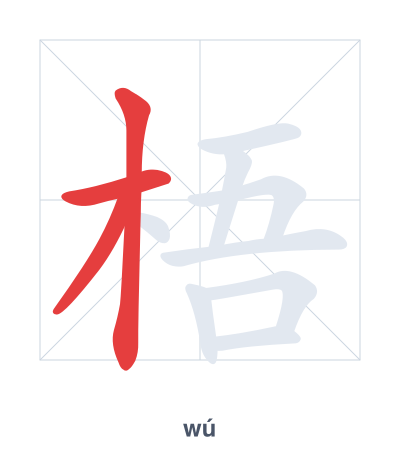
Open Hanzi Writer to see the animated stroke order and practice writing 梧 with real-time feedback.
The character 梧 (wú) is written with 11 strokes. Follow the standard Chinese stroke order: top to bottom, left to right, outside before inside. The radical 木 is one of its key components.
Practice the correct stroke order with the Hanzi Writer app to see animated stroke-by-stroke guidance with real-time feedback.
梧 means parasol tree.
梧 combines the radical 木 (tree) with 吾 (wú), which serves as a phonetic component. It refers to the parasol tree (Firmiana simplex), whose broad leaves resemble a parasol.
💡 Memory Tip: Picture a tree (木) with five (五) mouths (口) all shouting 'my! (吾)' as they unfurl huge leaves that look like a parasol.
路边种满了梧桐树。
lù biān zhǒng mǎn le wú tóng shù
The roadside is lined with plane trees.
秋天梧叶落了一地。
qiū tiān wú yè là le yī dì
In autumn, the leaves of the plane tree cover the ground.
那个运动员身材魁梧。
nà ge yùn dòng yuán shēn cái kuí wú
That athlete has a sturdy build.
Open Hanzi Writer to see the animated stroke order and practice writing 梧 with real-time feedback.
✨ Animated stroke order · Handwriting recognition · HSK-graded practice · Free to use
梧 is made of two parts: the left radical 木 (tree) and the right component 吾 (wú, which gives the sound). The 木 radical shows that 梧 is a type of tree, specifically the parasol tree. The right side 吾 is phonetic and does not contribute to the meaning.