槛 (kǎn) means "Threshold" in Chinese. It has 14 strokes with the radical 木, and is HSK Level 7.
Rated 4.2/5 in difficulty (advanced).
Harder than 64% of HSK Level 7 characters.
Appears in 3+ common words including 门槛 (mén kǎn), 门槛高 (mén kǎn gāo), 槛车 (kǎn chē).
Due to its 14 strokes, Hanzi Writer's error detection shows 槛 requires focused practice — most learners need 10+ attempts for consistent accuracy.
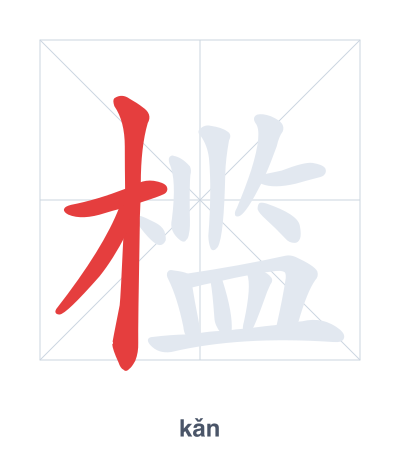
Open Hanzi Writer to see the animated stroke order and practice writing 槛 with real-time feedback.
The character 槛 (kǎn) is written with 14 strokes. Follow the standard Chinese stroke order: top to bottom, left to right, outside before inside. The radical 木 is one of its key components.
Practice the correct stroke order with the Hanzi Writer app to see animated stroke-by-stroke guidance with real-time feedback.
槛 means Threshold.
As an HSK Level 7 character, 槛 is an intermediate-level character.
This character is a phono-semantic compound: the radical 木 (wood) indicates the material, while 监 (jiān) provides the pronunciation. A threshold is traditionally a wooden plank or bar at the base of a doorway.
💡 Memory Tip: Imagine a wooden bar (木) across a door that monitors (监) who steps over it—that's the threshold.
进门时请小心脚下的门槛。
jìn mén shí qǐng xiǎo xīn jiǎo xià de mén kǎn
Please mind the threshold when entering the door.
这家公司的入职门槛很高。
zhè jiā gōng sī de rù zhí mén kǎn hěn gāo
The entry requirements for this company are very high.
古代用槛车运送犯人。
gǔ dài yòng kǎn chē yùn sòng fàn rén
Ancient times used caged carts to transport prisoners.
Open Hanzi Writer to see the animated stroke order and practice writing 槛 with real-time feedback.
✨ Animated stroke order · Handwriting recognition · HSK-graded practice · Free to use
The character 槛 is made of two parts: the left radical 木 (wood) and the right part 监 (jiān, meaning to supervise). Since a traditional threshold is a wooden bar at the bottom of a door, the wood radical directly hints at the material, while the right side suggests the function of overseeing who enters.