棋 (qí) means "chess or board game" in Chinese. It has 12 strokes with the radical 木, and is HSK Level 7.
Rated 4.2/5 in difficulty (advanced).
Harder than 64% of HSK Level 7 characters.
Appears in 3+ common words including 下棋 (xià qí), 围棋 (wéi qí), 象棋 (xiàng qí).
Due to its 12 strokes, Hanzi Writer's error detection shows 棋 requires focused practice — most learners need 10+ attempts for consistent accuracy.
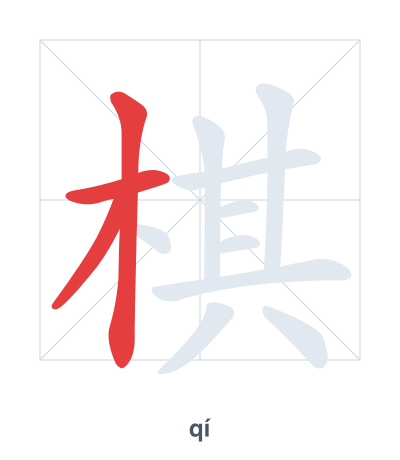
Open Hanzi Writer to see the animated stroke order and practice writing 棋 with real-time feedback.
The character 棋 (qí) is written with 12 strokes. Follow the standard Chinese stroke order: top to bottom, left to right, outside before inside. The radical 木 is one of its key components.
Practice the correct stroke order with the Hanzi Writer app to see animated stroke-by-stroke guidance with real-time feedback.
棋 means chess or board game.
As an HSK Level 7 character, 棋 is an intermediate-level character.
棋 combines the radical 木 (wood) with the phonetic component 其 (qí, meaning 'that' or 'its'), reflecting that ancient chess pieces were often carved from wood. The character originally referred to the game of chess or board games played with such pieces.
💡 Memory Tip: Imagine a wooden (木) board game where each piece sits on its own (其) square, forming the pattern of the character 棋.
爷爷喜欢在公园下棋。
yé yé xǐ huān zài gōng yuán xià qí
Grandpa likes playing chess in the park.
围棋是中国传统文化。
wéi qí shì zhōng guó chuán tǒng wén huà
Go is a part of traditional Chinese culture.
他象棋下得很好。
tā xiàng qí xià dé hěn hǎo
He plays chess very well.
Open Hanzi Writer to see the animated stroke order and practice writing 棋 with real-time feedback.
✨ Animated stroke order · Handwriting recognition · HSK-graded practice · Free to use
棋 is made of two parts: the left radical 木 (wood) and the right part 其 (qí, which provides sound). The wood radical hints at the ancient practice of carving chess pieces from wood, while 其 gives the character its pronunciation.