高 (gāo) means "high; tall" in Chinese. It has 10 strokes with the radical 高, and is HSK Level 1.
Rated 3/5 in difficulty (moderate).
Harder than 61% of HSK Level 1 characters.
Appears in 3+ common words including 高兴 (gāo xìng), 高大 (gāo dà), 高中 (gāo zhōng).
Hanzi Writer's stroke validation shows learners typically need 5-8 attempts to write 高 with correct proportion and order.
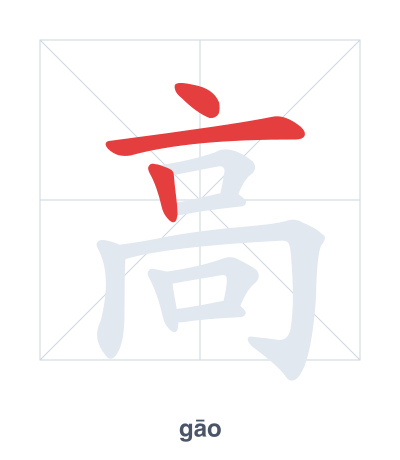
Open Hanzi Writer to see the animated stroke order and practice writing 高 with real-time feedback.
The character 高 (gāo) is written with 10 strokes. Follow the standard Chinese stroke order: top to bottom, left to right, outside before inside. The radical 高 is one of its key components.
Practice the correct stroke order with the Hanzi Writer app to see animated stroke-by-stroke guidance with real-time feedback.
高 means high; tall.
As an HSK Level 1 character, 高 is among the first characters beginners learn.
高 originally depicted a tall tower or watchtower, with the top part showing a roof or lookout platform and the lower part representing the base or a multi-story structure. Over time, the shape simplified but still evokes the image of something rising high above the ground.
💡 Memory Tip: Imagine a tall tower with a top platform (the top dot and horizontal lines) and a base (the lower rectangle), like a skyscraper reaching high into the sky.
见到你很高兴。
jiàn dào nǐ hěn gāo xìng
Nice to meet you.
那座山非常高大。
nà zuò shān fēi cháng gāo dà
That mountain is very tall and massive.
我明年上高中。
wǒ míng nián shàng gāo zhōng
I'll be starting high school next year.
Open Hanzi Writer to see the animated stroke order and practice writing 高 with real-time feedback.
✨ Animated stroke order · Handwriting recognition · HSK-graded practice · Free to use
The character 高 is a pictograph that resembles a tall building or tower with multiple floors. Its upper part looks like a roof (亠), and the lower parts are stacked boxes suggesting stories, directly conveying the idea of height or tallness. The radical is itself, reinforcing its meaning of 'high' or 'tall'.