棍 (gùn) means "stick or rod" in Chinese. It has 12 strokes with the radical 木, and is HSK Level 7.
Rated 4.2/5 in difficulty (advanced).
Harder than 64% of HSK Level 7 characters.
Appears in 3+ common words including 棍子 (gùn zi), 木棍 (mù gùn), 冰棍 (bīng gùn).
Due to its 12 strokes, Hanzi Writer's error detection shows 棍 requires focused practice — most learners need 10+ attempts for consistent accuracy.
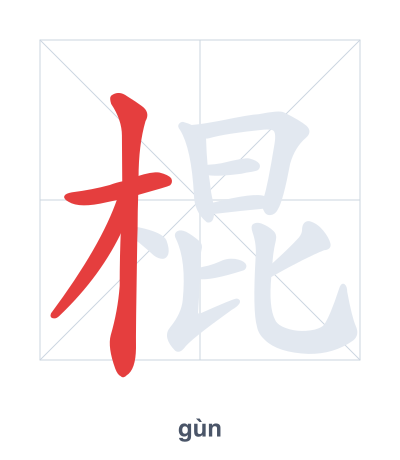
Open Hanzi Writer to see the animated stroke order and practice writing 棍 with real-time feedback.
The character 棍 (gùn) is written with 12 strokes. Follow the standard Chinese stroke order: top to bottom, left to right, outside before inside. The radical 木 is one of its key components.
Practice the correct stroke order with the Hanzi Writer app to see animated stroke-by-stroke guidance with real-time feedback.
棍 means stick or rod.
As an HSK Level 7 character, 棍 is an intermediate-level character.
棍 is a phono-semantic compound combining the radical 木 (wood/tree) indicating the material, and 昆 (kūn, elder brother) which provides the pronunciation. The character literally means a stick or rod made from wood.
💡 Memory Tip: Picture an elder brother (昆) using a wooden stick (木) to discipline his younger siblings.
这根棍子很长。
zhè gēn gùn zi hěn zhǎng
This stick is very long.
他手里拿着一根木棍。
tā shǒu lǐ ná zhe yī gēn mù gùn
He is holding a wooden stick in his hand.
夏天我喜欢吃冰棍。
xià tiān wǒ xǐ huān chī bīng gùn
I like eating popsicles in summer.
Open Hanzi Writer to see the animated stroke order and practice writing 棍 with real-time feedback.
✨ Animated stroke order · Handwriting recognition · HSK-graded practice · Free to use
棍 is a phono-semantic compound. The left part 木 (wood) indicates the material, and the right part 昆 (kūn) gives the sound. This matches the meaning of a stick or rod, which is often made of wood.