噘 (juē) means "to pout" in Chinese. It has 15 strokes with the radical 口.
Rated 4.2/5 in difficulty (advanced).
Appears in 3+ common words including 噘嘴 (juē zuǐ), 噘起嘴 (juē qǐ zuǐ), 噘着 (juē zhe).
Due to its 15 strokes, Hanzi Writer's error detection shows 噘 requires focused practice — most learners need 10+ attempts for consistent accuracy.
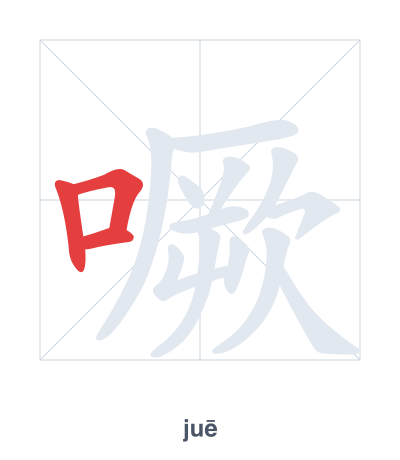
Open Hanzi Writer to see the animated stroke order and practice writing 噘 with real-time feedback.
The character 噘 (juē) is written with 15 strokes. Follow the standard Chinese stroke order: top to bottom, left to right, outside before inside. The radical 口 is one of its key components.
Practice the correct stroke order with the Hanzi Writer app to see animated stroke-by-stroke guidance with real-time feedback.
噘 means to pout.
噘 is a phono-semantic compound combining the mouth radical (口) with 厥 (jué) as the phonetic component. The radical indicates that the character relates to the mouth, while 厥 suggests the action of raising or protruding, like sticking out the lips to pout.
💡 Memory Tip: Picture a child pouting so hard that their lips (口) jut out like a cliff (厂) while they groan 'jue' – the shape of 厥 on the right looks like a frowning face with a big nose.
妹妹不高兴地噘着嘴。
mèi mèi bù gāo xìng dì juē zhe zuǐ
The younger sister pouted unhappily.
他噘起嘴来表示不满。
tā juē qǐ zuǐ lái biǎo shì bù mǎn
He pouted to show his dissatisfaction.
别老是噘着嘴。
bié lǎo shì juē zhe zuǐ
Don't keep pouting.
Open Hanzi Writer to see the animated stroke order and practice writing 噘 with real-time feedback.
✨ Animated stroke order · Handwriting recognition · HSK-graded practice · Free to use
噘 combines the radical 口 (mouth) on the left with 厥 on the right. Since pouting is an action done with the mouth, the 口 radical directly indicates the meaning, while 厥 provides the pronunciation juē.