踘 (jū) means "ancient ball (cuju)" in Chinese. It has 15 strokes with the radical 足.
Rated 4.2/5 in difficulty (advanced).
Appears in 3+ common words including 蹴踘 (cù jū), 踘场 (jū chǎng), 玩踘 (wán jū).
Due to its 15 strokes, Hanzi Writer's error detection shows 踘 requires focused practice — most learners need 10+ attempts for consistent accuracy.
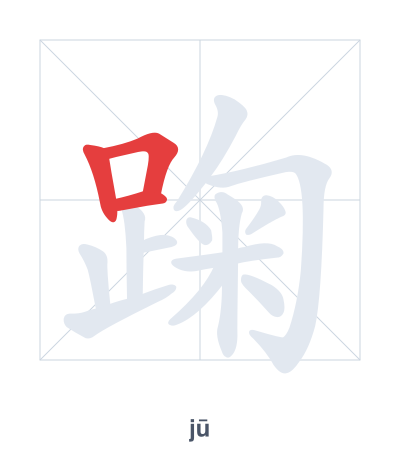
Open Hanzi Writer to see the animated stroke order and practice writing 踘 with real-time feedback.
The character 踘 (jū) is written with 15 strokes. Follow the standard Chinese stroke order: top to bottom, left to right, outside before inside. The radical 足 is one of its key components.
Practice the correct stroke order with the Hanzi Writer app to see animated stroke-by-stroke guidance with real-time feedback.
踘 means ancient ball (cuju).
This character is a phono-semantic compound. The left radical 足 (foot) indicates the action of kicking, while the right component 匊 (jū) provides the pronunciation and originally depicted hands cupping a ball, together representing the ball used in the ancient Chinese game of cuju (kickball).
💡 Memory Tip: Picture a foot (足) kicking a round, leather ball (匊) as in the ancient game of cuju.
古代人喜欢蹴踘。
gǔ dài rén xǐ huān cù jū
Ancient people liked playing Cuju (ancient football).
这里有一个踘场。
zhè lǐ yǒu yí gè jū chǎng
There is a Cuju field here.
孩子们在玩踘。
hái zi men zài wán jū
The children are playing with a ball.
Open Hanzi Writer to see the animated stroke order and practice writing 踘 with real-time feedback.
✨ Animated stroke order · Handwriting recognition · HSK-graded practice · Free to use
踘 is made of the radical 足 (foot) on the left and the component 匊 on the right. 足 suggests the character involves the foot or a kicking action, while 匊 gives the pronunciation jū and relates to a round object like a ball. Together they represent an ancient ball used in foot games.