蹴 (cù) means "to kick; to tread on" in Chinese. It has 19 strokes with the radical 足.
Rated 4.2/5 in difficulty (advanced).
Appears in 3+ common words including 蹴鞠 (cù jū), 一蹴而就 (yí cù ér jiù), 蹴踏 (cù tà).
Due to its 19 strokes, Hanzi Writer's error detection shows 蹴 requires focused practice — most learners need 10+ attempts for consistent accuracy.
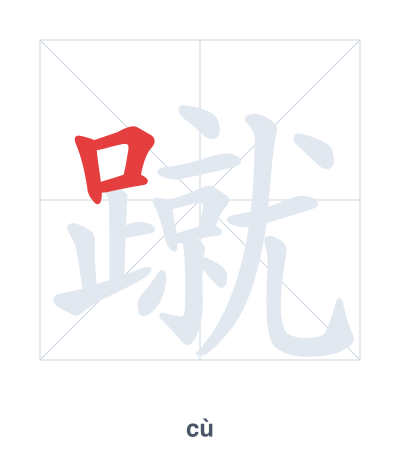
Open Hanzi Writer to see the animated stroke order and practice writing 蹴 with real-time feedback.
The character 蹴 (cù) is written with 19 strokes. Follow the standard Chinese stroke order: top to bottom, left to right, outside before inside. The radical 足 is one of its key components.
Practice the correct stroke order with the Hanzi Writer app to see animated stroke-by-stroke guidance with real-time feedback.
蹴 means to kick; to tread on.
蹴 combines the radical 足 (foot) with the phonetic component 就 (jiù, meaning 'to go to' or 'then'). The foot radical indicates the action involves the foot, while the phonetic suggests the sound or completion of the motion. Together, they depict the foot going toward something to kick or tread on it.
💡 Memory Tip: Picture a soccer player's foot (足) running to kick a ball, and then (就—sounds like 'juice') the ball splatters juice everywhere.
蹴鞠是古代的一种足球运动。
cù jū shì gǔ dài de yī zhǒng zú qiú yùn dòng
Cuju is a type of ancient football sport.
学习汉语不能一蹴而就。
xué xí hàn yǔ bù néng yí cù ér jiù
Learning Chinese cannot be achieved overnight.
请不要蹴踏草坪。
qǐng bú yào cù tà cǎo píng
Please do not trample the lawn.
Open Hanzi Writer to see the animated stroke order and practice writing 蹴 with real-time feedback.
✨ Animated stroke order · Handwriting recognition · HSK-graded practice · Free to use
蹴 is composed of the radical 足 (foot) on the left, which indicates actions involving the foot. The right part is 就 (jiù), which provides pronunciation and loosely suggests "to complete" or "to approach," so together 蹴 means "to kick" or "to tread on" using the foot.