Hanzi Writer

How to Write 颈 (jǐng) — Meaning “neck”

jǐng HSK Level 7 11 strokes Radical: 页

颈 (jǐng) means "neck" in Chinese. It has 11 strokes with the radical 页, and is HSK Level 7.

Rated 4.2/5 in difficulty (advanced).

Harder than 97% of HSK Level 7 characters.

Appears in 3+ common words including 颈部 (jǐng bù), 瓶颈 (píng jǐng), 颈椎 (jǐng chuí).

Due to its 11 strokes, Hanzi Writer's error detection shows 颈 requires focused practice — most learners need 10+ attempts for consistent accuracy.
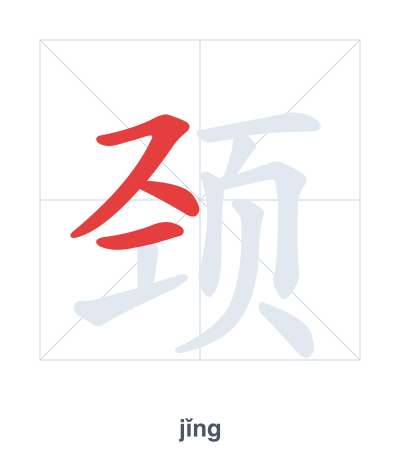
Stroke order practice for 颈 - jǐng

Practice Writing 颈 (jǐng)

Open Hanzi Writer to see the animated stroke order and practice writing 颈 with real-time feedback.

The character (jǐng) is written with 11 strokes. Follow the standard Chinese stroke order: top to bottom, left to right, outside before inside. The radical is one of its key components.

Practice the correct stroke order with the Hanzi Writer app to see animated stroke-by-stroke guidance with real-time feedback.

means neck.

As an HSK Level 7 character, is an intermediate-level character.

Character
Pinyinjǐng (jing)
Meaningneck
Strokes11
Radical
HSK Level7
Difficulty4.2/5

The character 颈 combines the radical 页, representing the head, with the phonetic component 巠, which originally depicted a straight line or passage, suggesting the neck as the connecting passage between head and body.

💡 Memory Tip: Picture a stiff straight line (巠) holding up your head (页) like a tight neck that feels as rigid as a ruler.

jǐng bù
neck area / neck
píng jǐng
bottleneck
jǐng chuí
cervical vertebra

他的颈部受伤了。

tā de jǐng bù shòu shāng le

His neck is injured.

我们遇到了技术瓶颈。

wǒ men yù dào le jì shù píng jǐng

We encountered a technical bottleneck.

看手机对颈椎不好。

kàn shǒu jī duì jǐng chuí bù hǎo

Looking at your phone is bad for your neck.

Character Pinyin Strokes Radical
(current) jǐng 11
hān 9
xiàng 9
shùn 9
Stroke order practice for 颈 - jǐng

Practice Writing 颈 (jǐng)

Open Hanzi Writer to see the animated stroke order and practice writing 颈 with real-time feedback.

✨ Animated stroke order · Handwriting recognition · HSK-graded practice · Free to use

Frequently Asked Questions about 颈

颈 is made of two parts: the left side 巠 (jīng) gives the sound, and the right side 页 (yè) means 'head' or 'page'. Since 页 originally referred to the head, combining it with 巠 creates the meaning 'neck', the part connecting the head to the body.

More HSK Level 7 Characters

Characters with Radical 页

Other 11-Stroke Characters