瓶 (píng) means "bottle" in Chinese. It has 10 strokes with the radical 瓦, and is HSK Level 2.
Rated 3.7/5 in difficulty (challenging).
Harder than 85% of HSK Level 2 characters.
Appears in 3+ common words including 瓶子 (píng zi), 水瓶 (shuǐ píng), 花瓶 (huā píng).
Due to its 10 strokes, Hanzi Writer's error detection shows 瓶 requires focused practice — most learners need 10+ attempts for consistent accuracy.
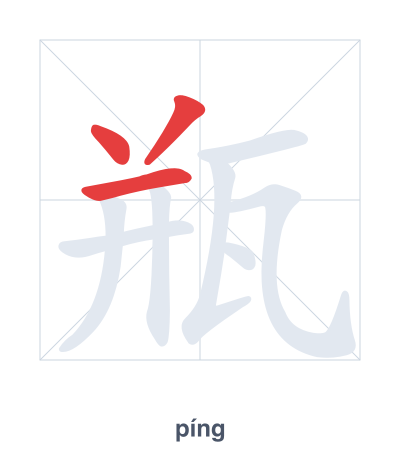
Open Hanzi Writer to see the animated stroke order and practice writing 瓶 with real-time feedback.
The character 瓶 (píng) is written with 10 strokes. Follow the standard Chinese stroke order: top to bottom, left to right, outside before inside. The radical 瓦 is one of its key components.
Practice the correct stroke order with the Hanzi Writer app to see animated stroke-by-stroke guidance with real-time feedback.
瓶 means bottle.
As an HSK Level 2 character, 瓶 is among the first characters beginners learn.
瓶 is a compound character combining 瓦 (tile/clayware) as the radical with 并 (combine) as a phonetic and semantic hint. The ancient idea is a bottle formed by joining pieces of clay together.
💡 Memory Tip: Imagine two clay pieces (并) being fused to form a round bottle (瓦) on a potter's wheel.
桌子上有一个瓶子。
zhuō zi shàng yǒu yí gè píng zi
There is a bottle on the table.
记得带上你的水瓶。
jì de dài shàng nǐ de shuǐ píng
Remember to bring your water bottle.
姐姐买了一个漂亮的花瓶。
jiě jiě mǎi le yí gè piào liàng de huā píng
My elder sister bought a beautiful vase.
Open Hanzi Writer to see the animated stroke order and practice writing 瓶 with real-time feedback.
✨ Animated stroke order · Handwriting recognition · HSK-graded practice · Free to use
瓶 is a left-right character. The left part 并 gives the sound (píng), and the right part 瓦 (wǎ) means 'tile' or 'pottery.' Together, they create the idea of a pottery container, which is the original meaning of 'bottle.'