椎 (chuí/zhuī) means "Vertebra / hammer-like object" in Chinese. It has 12 strokes with the radical 木.
Rated 4.2/5 in difficulty (advanced).
Appears in 3+ common words including 脊椎 (jǐ zhuī), 颈椎 (jǐng chuí), 椎骨 (chuí gǔ).
Due to its 12 strokes, Hanzi Writer's error detection shows 椎 requires focused practice — most learners need 10+ attempts for consistent accuracy.
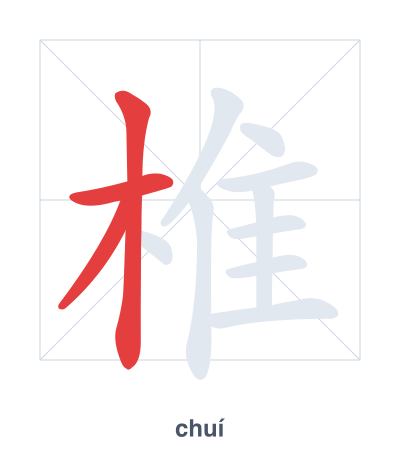
Open Hanzi Writer to see the animated stroke order and practice writing 椎 with real-time feedback.
The character 椎 (chuí/zhuī) is written with 12 strokes. Follow the standard Chinese stroke order: top to bottom, left to right, outside before inside. The radical 木 is one of its key components.
Practice the correct stroke order with the Hanzi Writer app to see animated stroke-by-stroke guidance with real-time feedback.
椎 means Vertebra / hammer-like object.
This is a polyphonic character with readings: chuí, zhuī.
椎 originally meant a wooden mallet or hammer, combining the radical 木 (tree/wood) with 隹 (short-tailed bird) as a phonetic component. The wooden hammer was used for pounding, and later the meaning extended to 'vertebra' because the spine resembles a stack of hammer-like bones.
💡 Memory Tip: Picture a bird (隹) perched on a wooden block (木) using it as a hammer to crack open a nut—that's the 椎.
他的脊椎受伤了。
tā de jǐ zhuī shòu shāng le
His spine is injured.
看手机太久对颈椎不好。
kàn shǒu jī tài jiǔ duì jǐng chuí bù hǎo
Looking at your phone for too long is bad for your neck.
医生检查了他的椎骨。
yī shēng jiǎn chá le tā de chuí gǔ
The doctor examined his vertebrae.
Open Hanzi Writer to see the animated stroke order and practice writing 椎 with real-time feedback.
✨ Animated stroke order · Handwriting recognition · HSK-graded practice · Free to use
椎 consists of the radical 木 (wood/tree) on the left and 隹 (a short-tailed bird) on the right. The wood radical suggests its original meaning of a wooden hammer or mallet, while 隹 provides the pronunciation chuí. Over time, the meaning extended to 'vertebra' because the shape of a vertebra resembles a hammer's head.