阱 (jǐng) means "Pitfall or trap." in Chinese. It has 6 strokes with the radical 阝, and is HSK Level 7.
Rated 2.9/5 in difficulty (moderate).
Harder than 8% of HSK Level 7 characters.
Appears in 2+ common words including 陷阱 (xiàn jǐng), 阱 (jǐng).
Hanzi Writer's stroke validation shows learners typically need 5-8 attempts to write 阱 with correct proportion and order.
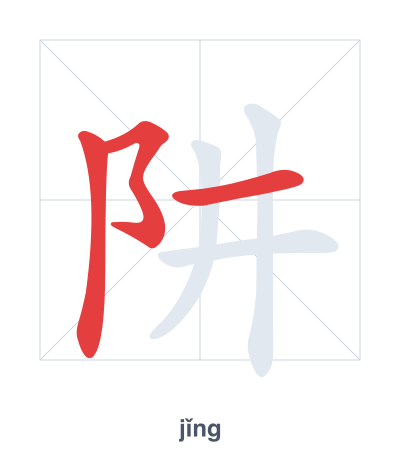
Open Hanzi Writer to see the animated stroke order and practice writing 阱 with real-time feedback.
The character 阱 (jǐng) is written with 6 strokes. Follow the standard Chinese stroke order: top to bottom, left to right, outside before inside. The radical 阝 is one of its key components.
Practice the correct stroke order with the Hanzi Writer app to see animated stroke-by-stroke guidance with real-time feedback.
阱 means Pitfall or trap..
As an HSK Level 7 character, 阱 is an intermediate-level character.
The character 阱 combines the radical 阝 (mound/hill) with 井 (well). Together, they depict a pit dug into the earth—like a well—used as a hidden trap on a hill or path.
💡 Memory Tip: Picture a mound (阝) beside a well (井) where an unsuspecting traveler falls into the hidden trap.
小心前面的陷阱。
xiǎo xīn qián miàn de xiàn jǐng
Watch out for the trap ahead.
这是一个深阱。
zhè shì yí gè shēn jǐng
This is a deep pit.
别掉进阱里。
bié diào jìn jǐng lǐ
Don't fall into the pit.
Open Hanzi Writer to see the animated stroke order and practice writing 阱 with real-time feedback.
✨ Animated stroke order · Handwriting recognition · HSK-graded practice · Free to use
The character 阱 is made of the radical 阝 on the left and the phonetic component 井 (jǐng, meaning 'well') on the right. The radical 阝 (originally 阜) represents a mound or hill, suggesting a hole or sunken area in the ground. Together, they depict a pit or well-like trap, matching the meaning 'pitfall or trap.'