荆 (jīng) means "thorns / brambles / the state of Chu" in Chinese. It has 9 strokes with the radical 艹, and is HSK Level 7.
Rated 3.7/5 in difficulty (challenging).
Harder than 30% of HSK Level 7 characters.
Appears in 3+ common words including 荆棘 (jīng jí), 披荆斩棘 (pī jīng zhǎn jí), 荆州 (jīng zhōu).
Due to its 9 strokes, Hanzi Writer's error detection shows 荆 requires focused practice — most learners need 10+ attempts for consistent accuracy.
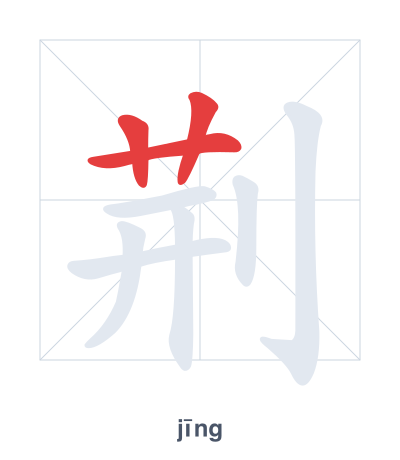
Open Hanzi Writer to see the animated stroke order and practice writing 荆 with real-time feedback.
The character 荆 (jīng) is written with 9 strokes. Follow the standard Chinese stroke order: top to bottom, left to right, outside before inside. The radical 艹 is one of its key components.
Practice the correct stroke order with the Hanzi Writer app to see animated stroke-by-stroke guidance with real-time feedback.
荆 means thorns / brambles / the state of Chu.
As an HSK Level 7 character, 荆 is an intermediate-level character.
荆 is a compound character with the grass radical (艹) indicating a plant, and 刑 (punishment) as a phonetic component that also hints at thorns being used for punishment. It originally referred to a thorny shrub, and later came to denote the ancient state of Chu because the region was overgrown with brambles.
💡 Memory Tip: Picture a grass (艹) that punishes (刑) you with painful scratches if you touch it — that's a thorny bramble.
前方的路布满荆棘。
qián fāng de lù bù mǎn jīng jí
The road ahead is full of thorns.
他披荆斩棘获得成功。
tā pī jīng zhǎn jí huò dé chéng gōng
He overcame all obstacles to achieve success.
荆州是一个古老的地方。
jīng zhōu shì yí gè gǔ lǎo de dì fāng
Jingzhou is an ancient place.
Open Hanzi Writer to see the animated stroke order and practice writing 荆 with real-time feedback.
✨ Animated stroke order · Handwriting recognition · HSK-graded practice · Free to use
The character 荆 is made of two parts: the top is the grass radical 艹, indicating it is a plant, and the bottom is 刑 (xíng), which gives the pronunciation. Together, they represent a thorny plant like brambles, because the 'punishment' element hints at the pain thorns can cause.