棘 (jí) means "thorns; brambles" in Chinese. It has 12 strokes with the radical 木, and is HSK Level 7.
Rated 3.9/5 in difficulty (challenging).
Harder than 36% of HSK Level 7 characters.
Appears in 3+ common words including 棘手 (jí shǒu), 荆棘 (jīng jí), 棘刺 (jí cì).
Due to its 12 strokes, Hanzi Writer's error detection shows 棘 requires focused practice — most learners need 10+ attempts for consistent accuracy.
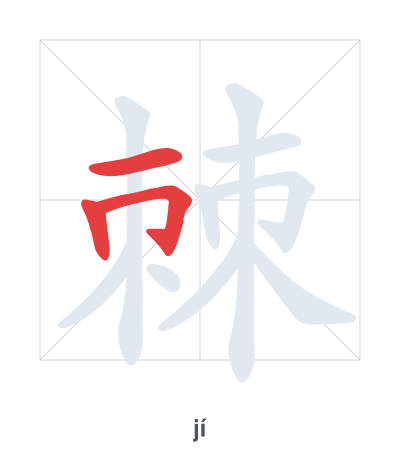
Open Hanzi Writer to see the animated stroke order and practice writing 棘 with real-time feedback.
The character 棘 (jí) is written with 12 strokes. Follow the standard Chinese stroke order: top to bottom, left to right, outside before inside. The radical 木 is one of its key components.
Practice the correct stroke order with the Hanzi Writer app to see animated stroke-by-stroke guidance with real-time feedback.
棘 means thorns; brambles.
As an HSK Level 7 character, 棘 is an intermediate-level character.
棘 is composed of two 朿 (cì, 'thorn') side by side, where each 朿 shows a tree (木) with spikes protruding—together they depict a dense thicket of thorns or brambles.
💡 Memory Tip: Picture two trees (木木) locked in a prickly fight, each sprouting vicious thorns that jab at anything that comes near.
这个问题处理起来很棘手。
zhè ge wèn tí chǔ lǐ qǐ lái hěn jí shǒu
This problem is very tricky to handle.
山路上到处都是荆棘。
shān lù shàng dào chù dōu shì jīng jí
The mountain road is covered with thorns everywhere.
这种植物身上长满了棘刺。
zhè zhòng zhí wù shēn shàng zhǎng mǎn le jí cì
This plant is covered with thorns.
Open Hanzi Writer to see the animated stroke order and practice writing 棘 with real-time feedback.
✨ Animated stroke order · Handwriting recognition · HSK-graded practice · Free to use
棘 is made of two 朿 (cì, thorn) components stacked vertically, showing thorns or brambles. Under each 朿 is a 木 (wood) radical, emphasizing that these thorns grow on woody plants. The repetition visually suggests many sharp points or dense thickets.