缰 (jiāng) means "Reins" in Chinese. It has 16 strokes with the radical 纟.
Rated 4.2/5 in difficulty (advanced).
Appears in 3+ common words including 缰绳 (jiāng shéng), 脱缰 (tuō jiāng), 勒缰 (lēi jiāng).
Due to its 16 strokes, Hanzi Writer's error detection shows 缰 requires focused practice — most learners need 10+ attempts for consistent accuracy.
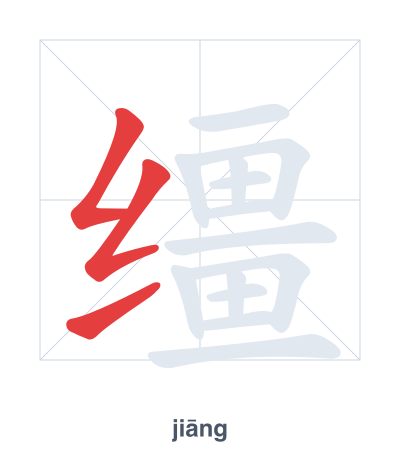
Open Hanzi Writer to see the animated stroke order and practice writing 缰 with real-time feedback.
The character 缰 (jiāng) is written with 16 strokes. Follow the standard Chinese stroke order: top to bottom, left to right, outside before inside. The radical 纟 is one of its key components.
Practice the correct stroke order with the Hanzi Writer app to see animated stroke-by-stroke guidance with real-time feedback.
缰 means Reins.
The character 缰 combines the radical 纟 (silk thread), indicating the material, with 畺 (jiāng, meaning 'boundary' or 'border'), which acts as a phonetic and also suggests the reins as a boundary that controls the horse's movement. Together, they form the idea of a silk cord used as reins to define the limit of a horse's freedom.
💡 Memory Tip: Imagine a silk rope (纟) stretched across a field boundary (畺) that you pull to steer a horse.
牵好马的缰绳。
qiān hǎo mǎ de jiāng shéng
Hold the horse's reins properly.
那匹马脱缰了。
nà pǐ mǎ tuō jiāng le
That horse broke free from its reins.
他用力勒缰。
tā yòng lì lēi jiāng
He pulled the reins hard.
Open Hanzi Writer to see the animated stroke order and practice writing 缰 with real-time feedback.
✨ Animated stroke order · Handwriting recognition · HSK-graded practice · Free to use
缰 is composed of the radical 纟 (silk thread) on the left, indicating something made of silk or cord, and the right side 畺 (jiāng, boundary) which hints at the character's pronunciation and suggests the idea of control or boundary. Together, they create the idea of a silk cord used to control a horse—a rein. The 纟 radical shows it's a rope or cord, while 畺 implies a boundary or limit that the rein enforces on the animal.