缥 (piāo) means "Light blue; ethereal; misty" in Chinese. It has 14 strokes with the radical 纟.
Rated 4.2/5 in difficulty (advanced).
Appears in 3+ common words including 缥缈 (piāo miǎo), 缥青 (piāo qīng), 缥帙 (piāo zhì).
Due to its 14 strokes, Hanzi Writer's error detection shows 缥 requires focused practice — most learners need 10+ attempts for consistent accuracy.
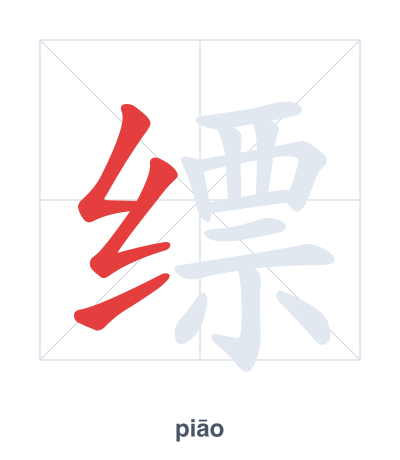
Open Hanzi Writer to see the animated stroke order and practice writing 缥 with real-time feedback.
The character 缥 (piāo) is written with 14 strokes. Follow the standard Chinese stroke order: top to bottom, left to right, outside before inside. The radical 纟 is one of its key components.
Practice the correct stroke order with the Hanzi Writer app to see animated stroke-by-stroke guidance with real-time feedback.
缥 means Light blue; ethereal; misty.
This character combines the silk radical (纟) with the phonetic component 票 (piào). Originally it referred to light blue silk fabric, and later extended to describe misty, ethereal, or hazy qualities like the color of distant mountains or smoke.
💡 Memory Tip: Picture a pale blue silk scarf (纟) fluttering in the wind like a floating ticket (票) disappearing into the mist.
云雾看起来很缥缈。
yún wù kàn qǐ lái hěn piāo miǎo
The clouds and mist look ethereal.
这种颜色叫缥青。
zhè zhǒng yán sè jiào piāo qīng
This color is called pale blue.
他整理了一些缥帙。
tā zhěng lǐ le yī xiē piāo zhì
He organized some books and scrolls.
Open Hanzi Writer to see the animated stroke order and practice writing 缥 with real-time feedback.
✨ Animated stroke order · Handwriting recognition · HSK-graded practice · Free to use
缥 is made of two parts: the left radical 纟 (silk thread) and the right part 票 (piào, ticket or vote). The silk radical suggests a connection to fabric or color, while 票 provides the sound and hints at something floating or drifting, leading to the meanings "light blue" and "ethereal."