缦 (màn) means "Plain silk; unadorned; slow" in Chinese. It has 14 strokes with the radical 纟.
Rated 4.2/5 in difficulty (advanced).
Appears in 3+ common words including 烂缦 (làn màn), 缦立 (màn lì), 缦回 (màn huí).
Due to its 14 strokes, Hanzi Writer's error detection shows 缦 requires focused practice — most learners need 10+ attempts for consistent accuracy.
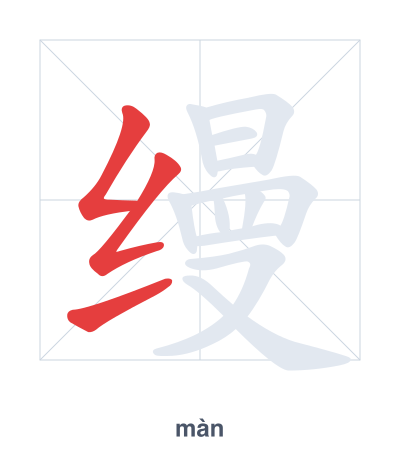
Open Hanzi Writer to see the animated stroke order and practice writing 缦 with real-time feedback.
The character 缦 (màn) is written with 14 strokes. Follow the standard Chinese stroke order: top to bottom, left to right, outside before inside. The radical 纟 is one of its key components.
Practice the correct stroke order with the Hanzi Writer app to see animated stroke-by-stroke guidance with real-time feedback.
缦 means Plain silk; unadorned; slow.
The character 缦 combines the silk radical 纟 with 曼, which originally depicted two hands reaching for a sun or eye, suggesting extension and slowness. Together, they signify plain, unadorned silk—fabric left in its natural, undyed state—and by extension, the idea of being slow or unhurried. The 曼 component carries both a phonetic hint (màn) and a semantic nuance of length or delay.
💡 Memory Tip: Picture a long, plain silk ribbon (纟) drifting slowly (曼) in the wind, unadorned and unhurried.
山上的花开得烂缦。
shān shàng de huā kāi dé làn màn
The flowers on the mountain are blooming brilliantly.
宫女们在廊下缦立。
gōng nǚ men zài láng xià màn lì
The palace maids stood waiting under the corridor.
走廊曲折缦回。
zǒu láng qū zhé màn huí
The corridor is winding and long.
Open Hanzi Writer to see the animated stroke order and practice writing 缦 with real-time feedback.
✨ Animated stroke order · Handwriting recognition · HSK-graded practice · Free to use
缦 is made of the radical 纟 (silk) on the left and 曼 on the right. The silk radical connects to fabrics, while 曼 can mean 'slow' or 'prolonged,' together giving the sense of plain, unadorned silk or something unhurried.