绳 (shéng) means "rope; cord" in Chinese. It has 11 strokes with the radical 纟, and is HSK Level 7.
Rated 4.2/5 in difficulty (advanced).
Harder than 80% of HSK Level 7 characters.
Appears in 3+ common words including 绳子 (shéng zi), 跳绳 (tiào shéng), 粗绳 (cū shéng).
Due to its 11 strokes, Hanzi Writer's error detection shows 绳 requires focused practice — most learners need 10+ attempts for consistent accuracy.
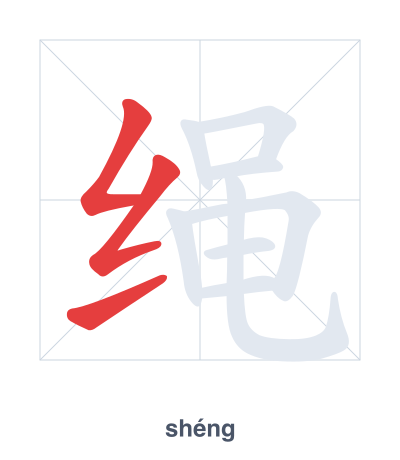
Open Hanzi Writer to see the animated stroke order and practice writing 绳 with real-time feedback.
The character 绳 (shéng) is written with 11 strokes. Follow the standard Chinese stroke order: top to bottom, left to right, outside before inside. The radical 纟 is one of its key components.
Practice the correct stroke order with the Hanzi Writer app to see animated stroke-by-stroke guidance with real-time feedback.
绳 means rope; cord.
As an HSK Level 7 character, 绳 is an intermediate-level character.
绳 is a phono-semantic compound. The left side 纟 (silk thread) indicates the material, while the right side 黾 (originally a pictograph of a frog) provides the pronunciation. Together they form the character meaning rope or cord made of silk or fiber.
💡 Memory Tip: Imagine a silk thread (纟) tightly wrapped around a frog (黾) to make a rope.
用绳子把盒子捆好。
yòng shéng zi bǎ hé zi kǔn hǎo
Tie the box up securely with rope.
妹妹喜欢跳绳。
mèi mèi xǐ huān tiào shéng
My younger sister likes jumping rope.
这根粗绳很结实。
zhè gēn cū shéng hěn jiē shí
This thick rope is very strong.
Open Hanzi Writer to see the animated stroke order and practice writing 绳 with real-time feedback.
✨ Animated stroke order · Handwriting recognition · HSK-graded practice · Free to use
The left side is the radical 纟, which means silk or thread, showing that ropes are often made from twisted fibers. The right side is 黾, which originally meant frog but here provides pronunciation (shéng) rather than meaning. Together, the character visually suggests a fibrous (纟) object used for binding.