济 (jǐ/jì) means "to cross a river; to aid; to relieve" in Chinese. It has 9 strokes with the radical 氵, and is HSK Level 3.
Rated 4/5 in difficulty (challenging).
Harder than 65% of HSK Level 3 characters.
Appears in 3+ common words including 救济 (jiù jì), 经济 (jīng jì), 济济一堂 (jǐ jǐ yī táng).
Due to its 9 strokes, Hanzi Writer's error detection shows 济 requires focused practice — most learners need 10+ attempts for consistent accuracy.
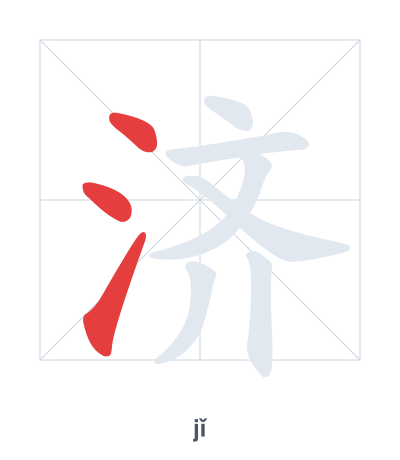
Open Hanzi Writer to see the animated stroke order and practice writing 济 with real-time feedback.
The character 济 (jǐ/jì) is written with 9 strokes. Follow the standard Chinese stroke order: top to bottom, left to right, outside before inside. The radical 氵 is one of its key components.
Practice the correct stroke order with the Hanzi Writer app to see animated stroke-by-stroke guidance with real-time feedback.
济 means to cross a river; to aid; to relieve.
This is a polyphonic character with readings: jǐ, jì.
As an HSK Level 3 character, 济 is an intermediate-level character.
The left side 氵(water) and right side 齐 (to arrange) together suggest people crossing a river in an orderly manner. This is the original meaning, which later extended to 'to aid' or 'to relieve'—helping others safely across life's difficulties.
💡 Memory Tip: Visualize a river (氵) where people line up evenly (齐) as a ferryman helps each one cross to the other side.
政府拨款用于救济那些受灾严重的贫困家庭。
zhèng fǔ bō kuǎn yòng yú jiù jì nà xiē shòu zāi yán zhòng de pín kùn jiā tíng
The government allocated funds to provide relief to those poor families severely affected by the disaster.
这个国家的旅游业对国民经济贡献巨大。
zhè ge guó jiā de lǚ yóu yè duì guó mín jīng jì gòng xiàn jù dà
The tourism industry of this country makes a huge contribution to the national economy.
礼堂里人才济济一堂,共同探讨科研难题。
lǐ táng lǐ rén cái jǐ jǐ yī táng gòng tóng tàn tǎo kē yán nán tí
The hall is filled with talented people discussing scientific research challenges together.
Open Hanzi Writer to see the animated stroke order and practice writing 济 with real-time feedback.
✨ Animated stroke order · Handwriting recognition · HSK-graded practice · Free to use
济 is made of two parts: the radical 氵 (water) on the left and the component 齐 (qí, meaning 'neat' or 'equal') on the right. The water radical suggests crossing a river, while 齐 adds the idea of helping or making things orderly, so together they mean 'to aid' or 'to relieve'.