渴 (kě) means "Thirsty" in Chinese. It has 12 strokes with the radical 氵, and is HSK Level 1.
Rated 3.7/5 in difficulty (challenging).
Harder than 91% of HSK Level 1 characters.
Appears in 3+ common words including 口渴 (kǒu kě), 渴了 (kě le), 渴望 (kě wàng).
Due to its 12 strokes, Hanzi Writer's error detection shows 渴 requires focused practice — most learners need 10+ attempts for consistent accuracy.
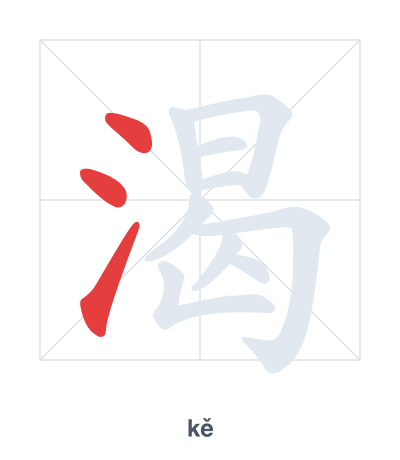
Open Hanzi Writer to see the animated stroke order and practice writing 渴 with real-time feedback.
The character 渴 (kě) is written with 12 strokes. Follow the standard Chinese stroke order: top to bottom, left to right, outside before inside. The radical 氵 is one of its key components.
Practice the correct stroke order with the Hanzi Writer app to see animated stroke-by-stroke guidance with real-time feedback.
渴 means Thirsty.
As an HSK Level 1 character, 渴 is among the first characters beginners learn.
The character 渴 combines the water radical (氵) with the phonetic component 曷, which originally depicted a person with a covered mouth, suggesting the sensation of having one's water supply cut off—hence thirst.
💡 Memory Tip: Picture a person (曷) desperately reaching for water (氵) but their mouth is blocked by a lid, leaving them parched.
我觉得口渴了。
wǒ jué de kǒu kě le
I feel thirsty.
你渴了吗?
nǐ kě le ma
Are you thirsty?
他渴望去中国。
tā kě wàng qù zhōng guó
He longs to go to China.
Open Hanzi Writer to see the animated stroke order and practice writing 渴 with real-time feedback.
✨ Animated stroke order · Handwriting recognition · HSK-graded practice · Free to use
The left side is the water radical 氵, showing that thirst relates to water. The right side 曷 (hé) is a phonetic component that hints at the pronunciation kě, though its original meaning does not directly connect to thirst.