Hanzi Writer

How to Write 踝 (huái) — Meaning “ankle”

huái 15 strokes Radical: 足

踝 (huái) means "ankle" in Chinese. It has 15 strokes with the radical 足.

Rated 4.2/5 in difficulty (advanced).

Appears in 3+ common words including 脚踝 (jiǎo huái), 踝关节 (huái guān jié), 扭伤脚踝 (niǔ shāng jiǎo huái).

Due to its 15 strokes, Hanzi Writer's error detection shows 踝 requires focused practice — most learners need 10+ attempts for consistent accuracy.
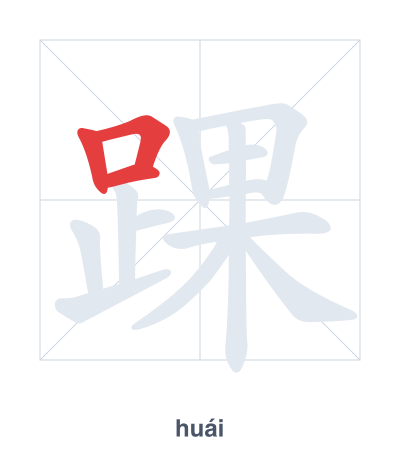
Stroke order practice for 踝 - huái

Practice Writing 踝 (huái)

Open Hanzi Writer to see the animated stroke order and practice writing 踝 with real-time feedback.

The character (huái) is written with 15 strokes. Follow the standard Chinese stroke order: top to bottom, left to right, outside before inside. The radical is one of its key components.

Practice the correct stroke order with the Hanzi Writer app to see animated stroke-by-stroke guidance with real-time feedback.

means ankle.

Character
Pinyinhuái (huai)
Meaningankle
Strokes15
Radical
Difficulty4.2/5

踝 is a compound character. The left component 足 (foot) indicates the meaning relates to the foot, while the right component 果 (fruit) provides phonetic hint and also visually suggests a rounded shape. The ankle is the ball-like joint where the foot meets the leg.

💡 Memory Tip: Picture a round fruit (果) perched on your foot (足) right where your ankle bends.

jiǎo huái
ankle
huái guān jié
ankle joint
niǔ shāng jiǎo huái
to sprain one's ankle

我的脚踝受伤了。

wǒ de jiǎo huái shòu shāng le

My ankle is injured.

踝关节很重要。

huái guān jié hěn zhòng yào

The ankle joint is very important.

他不小心扭伤脚踝。

tā bù xiǎo xīn niǔ shāng jiǎo huái

He accidentally sprained his ankle.

Character Pinyin Strokes Radical
(current) huái 15
tāng 15
gēn 13
xiǎn 13
Stroke order practice for 踝 - huái

Practice Writing 踝 (huái)

Open Hanzi Writer to see the animated stroke order and practice writing 踝 with real-time feedback.

✨ Animated stroke order · Handwriting recognition · HSK-graded practice · Free to use

Frequently Asked Questions about 踝

The left component is 足 (zú), meaning "foot," which shows the character relates to the foot or leg. The right component is 果 (guǒ), which gives the pronunciation huái and originally meant "fruit." Together, 踝 refers to the ankle, a fruit-shaped bone in the foot area.

Characters with Radical 足

Other 15-Stroke Characters