醐 (hú) means "clarified butter" in Chinese. It has 16 strokes with the radical 酉.
Rated 4.2/5 in difficulty (advanced).
Appears in 3+ common words including 醍醐 (tí hú), 醍醐灌顶 (tí hú guàn dǐng), 醍醐味 (tí hú wèi).
Due to its 16 strokes, Hanzi Writer's error detection shows 醐 requires focused practice — most learners need 10+ attempts for consistent accuracy.
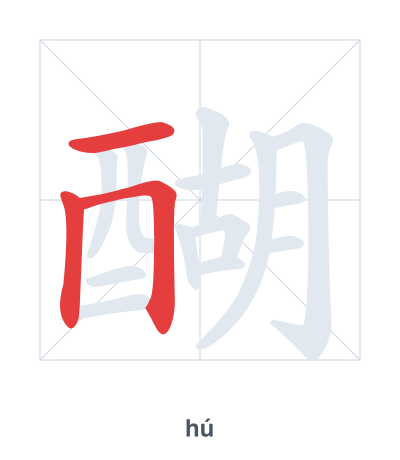
Open Hanzi Writer to see the animated stroke order and practice writing 醐 with real-time feedback.
The character 醐 (hú) is written with 16 strokes. Follow the standard Chinese stroke order: top to bottom, left to right, outside before inside. The radical 酉 is one of its key components.
Practice the correct stroke order with the Hanzi Writer app to see animated stroke-by-stroke guidance with real-time feedback.
醐 means clarified butter.
醐 combines the radical 酉 (a wine jar, indicating a liquid or processed food) with 胡 (hú, a phonetic component that also evokes 'foreign' or 'northern tribes'), reflecting clarified butter as a refined fatty product associated with Central Asian or nomadic cuisine.
💡 Memory Tip: Picture a jar of golden butter (酉) being churned by a bearded foreigner (胡) to create a rich, clarified essence.
醍醐是牛奶的精华。
tí hú shì niú nǎi de jīng huá
Tihu is the essence of milk.
老师的教导如醍醐灌顶。
lǎo shī de jiào dǎo rú tí hú guàn dǐng
The teacher's teaching was like a sudden enlightenment.
这道菜有醍醐味。
zhè dào cài yǒu tí hú wèi
This dish has a sublime and exquisite flavor.
Open Hanzi Writer to see the animated stroke order and practice writing 醐 with real-time feedback.
✨ Animated stroke order · Handwriting recognition · HSK-graded practice · Free to use
The left radical 酉 (meaning wine or fermented liquid) suggests a liquid-related substance. The right part 胡 provides the pronunciation hú and also carries the idea of 'foreign' or 'barbarian', as clarified butter was a foreign product. Together, these components create the meaning of clarified butter, a refined dairy product.