酴 (tú) means "yeast or leaven" in Chinese. It has 14 strokes with the radical 酉.
Rated 4.2/5 in difficulty (advanced).
Appears in 3+ common words including 酴醿 (tú mí), 酴酒 (tú jiǔ), 酴醾 (tú mí).
Due to its 14 strokes, Hanzi Writer's error detection shows 酴 requires focused practice — most learners need 10+ attempts for consistent accuracy.
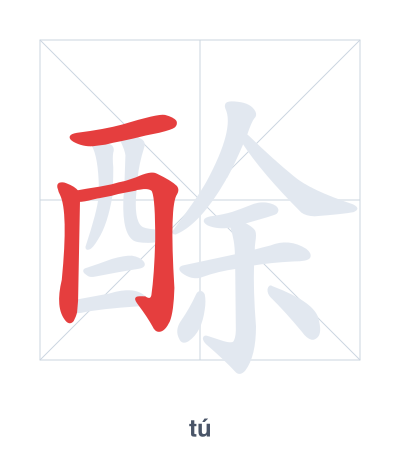
Open Hanzi Writer to see the animated stroke order and practice writing 酴 with real-time feedback.
The character 酴 (tú) is written with 14 strokes. Follow the standard Chinese stroke order: top to bottom, left to right, outside before inside. The radical 酉 is one of its key components.
Practice the correct stroke order with the Hanzi Writer app to see animated stroke-by-stroke guidance with real-time feedback.
酴 means yeast or leaven.
This character combines the radical 酉 (wine jar, indicating fermentation) with 余 (yú, meaning 'surplus' or 'remainder'), suggesting leftover grain used to start fermentation. The 酉 component visually ties it to brewing, while 余 hints at the residual yeast that continues the process.
💡 Memory Tip: Imagine a wine jar (酉) filled with leftover grain (余) bubbling into active yeast for your next brew.
院子里开了酴醿花。
yuàn zi lǐ kāi le tú mí huā
Tumi flowers are blooming in the yard.
他在喝一杯酴酒。
tā zài hē yī bēi tú jiǔ
He is drinking a cup of unfiltered wine.
酴醾花很漂亮。
tú mí huā hěn piào liàng
The climbing rose flowers are very beautiful.
Open Hanzi Writer to see the animated stroke order and practice writing 酴 with real-time feedback.
✨ Animated stroke order · Handwriting recognition · HSK-graded practice · Free to use
酴 is made of two parts: the radical 酉 on the left, which represents wine or fermentation, and 余 on the right, meaning surplus or leftover. Together they suggest leftover grains or ingredients used to make yeast or leaven for brewing.