乂 (yì) means "To govern, nurture, or a rare character meaning 'to mow'." in Chinese. It has 2 strokes with the radical 丿.
Rated 1.9/5 in difficulty (beginner-friendly).
Appears in 3+ common words including 乂安 (yì ān), 惩乂 (chéng yì), 乂字 (yì zì).
In the Hanzi Writer app, most learners master 乂 within 3 practice attempts using stroke-by-stroke animation.
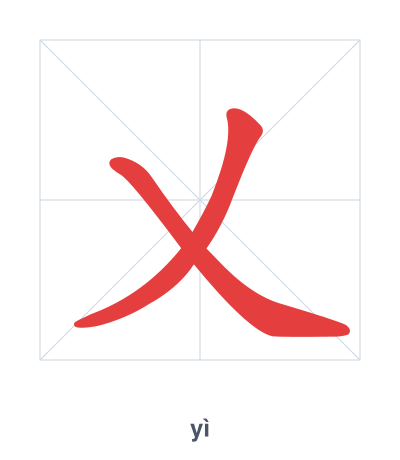
Open Hanzi Writer to see the animated stroke order and practice writing 乂 with real-time feedback.
The character 乂 (yì) is written with 2 strokes. Follow the standard Chinese stroke order: top to bottom, left to right, outside before inside. The radical 丿 is one of its key components.
Practice the correct stroke order with the Hanzi Writer app to see animated stroke-by-stroke guidance with real-time feedback.
乂 means To govern, nurture, or a rare character meaning 'to mow'..
| Character | 乂 |
| Pinyin | yì (yi) |
| Meaning | To govern, nurture, or a rare character meaning 'to mow'. |
| Strokes | 2 |
| Radical | 丿 |
| Difficulty | 1.9/5 |
乂 is a pictograph of a knife or sickle, used for mowing grass. Its simple form of two intersecting strokes mirrors a cutting blade, giving rise to meanings like 'to mow' and later 'to govern' or 'nurture' — as in controlling growth like a gardener.
💡 Memory Tip: Imagine a giant pair of crossed scissors (乂) snipping away weeds to 'govern' your garden.
乂安是一个地名。
yì ān shì yí gè dì míng
Nghe An is a place name.
这个词在古文中表示治理。
zhè ge cí zài gǔ wén zhōng biǎo shì zhì lǐ
This word means 'to govern' in ancient Chinese.
乂字只有简单的两画。
yì zì zhǐ yǒu jiǎn dān de liǎng huà
The character 'yì' (乂) has only two simple strokes.
Open Hanzi Writer to see the animated stroke order and practice writing 乂 with real-time feedback.
✨ Animated stroke order · Handwriting recognition · HSK-graded practice · Free to use
乂 is made of two crossing strokes: a left-falling stroke (丿) and a right-falling stroke (捺), forming an X shape. This simple cross pattern may symbolize cutting or mowing grass, which connects to its meanings of 'to mow' and 'to govern' (as in cutting away disorder).