Hanzi Writer

How to Write 乏 (fá) — Meaning “tired / weary / lacking”

HSK Level 5 4 strokes Radical: 丿

乏 (fá) means "tired / weary / lacking" in Chinese. It has 4 strokes with the radical 丿, and is HSK Level 5.

Rated 2.4/5 in difficulty (moderate).

Harder than 2% of HSK Level 5 characters.

Appears in 3+ common words including 缺乏 (quē fá), 疲乏 (pí fá), 乏味 (fá wèi).

Hanzi Writer's stroke validation shows learners typically need 5-8 attempts to write 乏 with correct proportion and order.
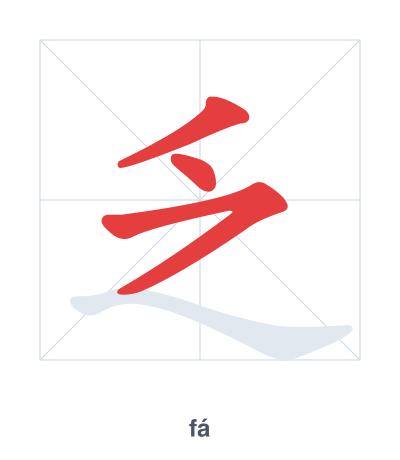
Stroke order practice for 乏 - fá

Practice Writing 乏 (fá)

Open Hanzi Writer to see the animated stroke order and practice writing 乏 with real-time feedback.

The character (fá) is written with 4 strokes. Follow the standard Chinese stroke order: top to bottom, left to right, outside before inside. The radical 丿 is one of its key components.

Practice the correct stroke order with the Hanzi Writer app to see animated stroke-by-stroke guidance with real-time feedback.

means tired / weary / lacking.

As an HSK Level 5 character, is an intermediate-level character.

Character
Pinyinfá (fa)
Meaningtired / weary / lacking
Strokes4
Radical丿
HSK Level5
Difficulty2.4/5

乏 originally depicted a person bending over in exhaustion, with the slanted stroke 丿 representing a weary, stooped body. This visual of a tired figure also conveyed the sense of lacking energy or resources, giving the character its dual meanings of fatigue and deficiency.

💡 Memory Tip: Picture a tired person with a bent back (丿) dragging their feet (之) because they lack the energy to walk straight.

quē fá
to lack
pí fá
fatigued
fá wèi
dull / boring / tasteless

身体缺乏水分。

shēn tǐ quē fá shuǐ fèn

The body lacks water; dehydrated.

他感到很疲乏。

tā gǎn dào hěn pí fá

He felt very fatigued.

这个故事很乏味。

zhè ge gù shì hěn fá wèi

This story is very dull.

Character Pinyin Strokes Radical
(current) 4 丿
dān 4 丿
2 丿
nǎi 2 丿
Stroke order practice for 乏 - fá

Practice Writing 乏 (fá)

Open Hanzi Writer to see the animated stroke order and practice writing 乏 with real-time feedback.

✨ Animated stroke order · Handwriting recognition · HSK-graded practice · Free to use

Frequently Asked Questions about 乏

乏 is composed of the radical 丿 (a downward left stroke) and a modified form of 之 (meaning 'to go'). The upper part 乛 suggests a bent shape, and the whole character visually represents someone who is bent over from exhaustion or something that is missing.

More HSK Level 5 Characters

Characters with Radical 丿

Other 4-Stroke Characters