嚆 (hāo) means "Sound of a whistle / To call out" in Chinese. It has 16 strokes with the radical 口.
Rated 4.2/5 in difficulty (advanced).
Appears in 3+ common words including 嚆矢 (hāo shǐ), 嚆呼 (hāo hū), 嚆嚆 (hāo hāo).
Due to its 16 strokes, Hanzi Writer's error detection shows 嚆 requires focused practice — most learners need 10+ attempts for consistent accuracy.
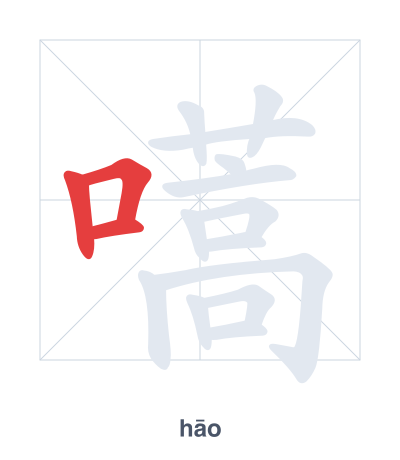
Open Hanzi Writer to see the animated stroke order and practice writing 嚆 with real-time feedback.
The character 嚆 (hāo) is written with 16 strokes. Follow the standard Chinese stroke order: top to bottom, left to right, outside before inside. The radical 口 is one of its key components.
Practice the correct stroke order with the Hanzi Writer app to see animated stroke-by-stroke guidance with real-time feedback.
嚆 means Sound of a whistle / To call out.
嚆 is a compound character formed from the mouth radical 口 (indicating sound or speech) and the phonetic component 蒿 (hāo, meaning 'wormwood'). The character originally depicted the sound of a whistle or a loud call, linking the mouth's action to the phonetic element's pronunciation.
💡 Memory Tip: Picture someone shouting through a high (高) whistle made of wormwood (蒿) grass, making a piercing sound from the mouth (口).
这是文学的嚆矢。
zhè shì wén xué de hāo shǐ
This is the precursor of literature.
远处传来一阵嚆呼。
yuǎn chù chuán lái yī zhèn hāo hū
A loud shout came from the distance.
声音嚆嚆不绝。
shēng yīn hāo hāo bù jué
The sound is howling incessantly.
Open Hanzi Writer to see the animated stroke order and practice writing 嚆 with real-time feedback.
✨ Animated stroke order · Handwriting recognition · HSK-graded practice · Free to use
嚆 combines the mouth radical 口 on the left with the phonetic component 蒿 (hāo) on the right. The mouth radical indicates that the character relates to sounds made by the mouth, while 蒿 provides the pronunciation. Together they form a character for shouting or a whistling noise.