宓 (mì) means "Quiet / Silent" in Chinese. It has 8 strokes with the radical 宀.
Rated 3.7/5 in difficulty (challenging).
Appears in 3+ common words including 宓静 (mì jìng), 宓穆 (mì mù), 姓宓 (xìng mì).
Due to its 8 strokes, Hanzi Writer's error detection shows 宓 requires focused practice — most learners need 10+ attempts for consistent accuracy.
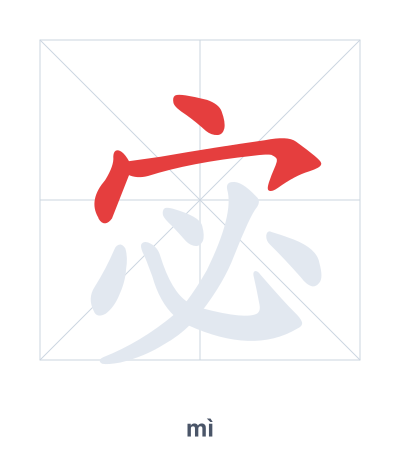
Open Hanzi Writer to see the animated stroke order and practice writing 宓 with real-time feedback.
The character 宓 (mì) is written with 8 strokes. Follow the standard Chinese stroke order: top to bottom, left to right, outside before inside. The radical 宀 is one of its key components.
Practice the correct stroke order with the Hanzi Writer app to see animated stroke-by-stroke guidance with real-time feedback.
宓 means Quiet / Silent.
宓 is a compound character combining the radical 宀 (roof) with 必 (bì) as a phonetic component. The roof suggests a sheltered, indoor setting, which connects to the meaning of quiet or silent—a place where peace and stillness prevail.
💡 Memory Tip: Under the roof (宀) you must (必) stay quiet – that's 宓.
环境非常宓静。
huán jìng fēi cháng mì jìng
The environment is very peaceful and quiet.
这里的气氛很宓穆。
zhè lǐ de qì fēn hěn mì mù
The atmosphere here is very peaceful and solemn.
他姓宓。
tā xìng mì
His surname is Mi.
Open Hanzi Writer to see the animated stroke order and practice writing 宓 with real-time feedback.
✨ Animated stroke order · Handwriting recognition · HSK-graded practice · Free to use
宓 is made of the radical 宀 (roof) on top and 必 (bì, surely) below. The roof suggests a sheltered indoor space, and the idea of being under a roof with certainty can imply stillness and quietness. Together, they create the sense of a peaceful, silent atmosphere inside.