宕 (dàng) means "To delay / Stall" in Chinese. It has 8 strokes with the radical 宀.
Rated 3.7/5 in difficulty (challenging).
Appears in 3+ common words including 跌宕 (diē dàng), 延宕 (yán dàng), 宕机 (dàng jī).
Due to its 8 strokes, Hanzi Writer's error detection shows 宕 requires focused practice — most learners need 10+ attempts for consistent accuracy.
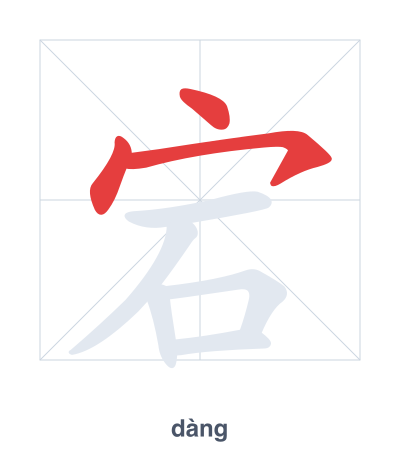
Open Hanzi Writer to see the animated stroke order and practice writing 宕 with real-time feedback.
The character 宕 (dàng) is written with 8 strokes. Follow the standard Chinese stroke order: top to bottom, left to right, outside before inside. The radical 宀 is one of its key components.
Practice the correct stroke order with the Hanzi Writer app to see animated stroke-by-stroke guidance with real-time feedback.
宕 means To delay / Stall.
This compound character combines a roof (宀) over a stone (石), originally depicting a stone cave or grotto. Over time, the meaning shifted to 'to delay or stall,' possibly from the idea of being idle or lingering in such a cave.
💡 Memory Tip: Picture a stone (石) blocking the doorway under a roof (宀), forcing you to stall and delay your entry.
故事情节很跌宕。
gù shì qíng jié hěn diē dàng
The plot of the story is full of twists and turns.
工作不能再延宕了。
gōng zuò bù néng zài yán dàng le
Work cannot be delayed any longer.
电脑宕机了。
diàn nǎo dàng jī le
The computer crashed.
Open Hanzi Writer to see the animated stroke order and practice writing 宕 with real-time feedback.
✨ Animated stroke order · Handwriting recognition · HSK-graded practice · Free to use
宕 consists of the radical 宀 (roof) on top and 石 (stone) below. The roof suggests a covering or house, and the stone may represent a heavy object blocking the way. Together they evoke the idea of something being obstructed or held up, leading to a delay or stall.