姑 (gū) means "paternal aunt" in Chinese. It has 8 strokes with the radical 女, and is HSK Level 3.
Rated 3.7/5 in difficulty (challenging).
Harder than 48% of HSK Level 3 characters.
Appears in 3+ common words including 姑娘 (gū niáng), 姑姑 (gū gū), 姑妈 (gū mā).
Due to its 8 strokes, Hanzi Writer's error detection shows 姑 requires focused practice — most learners need 10+ attempts for consistent accuracy.
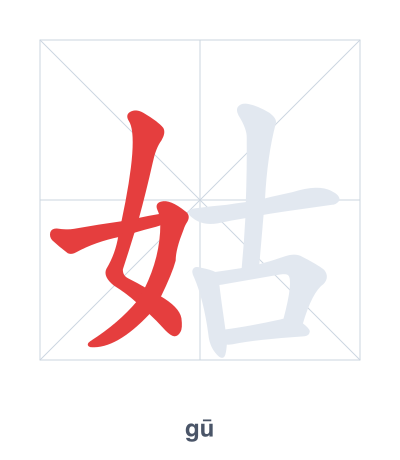
Open Hanzi Writer to see the animated stroke order and practice writing 姑 with real-time feedback.
The character 姑 (gū) is written with 8 strokes. Follow the standard Chinese stroke order: top to bottom, left to right, outside before inside. The radical 女 is one of its key components.
Practice the correct stroke order with the Hanzi Writer app to see animated stroke-by-stroke guidance with real-time feedback.
姑 means paternal aunt.
As an HSK Level 3 character, 姑 is an intermediate-level character.
姑 is a phono-semantic compound: the radical 女 (woman) indicates a female relative, while 古 (gǔ, 'ancient') provides the sound and hints at an older generation. Originally it referred to one's father's sister, an 'ancient woman' in the family hierarchy.
💡 Memory Tip: Picture an ancient (古) woman (女) in a traditional robe, affectionately pinching your cheek—that's your paternal aunt (姑).
那个姑娘很漂亮。
nà ge gū niáng hěn piào liàng
That girl is very beautiful.
我姑姑在医院工作。
wǒ gū gū zài yī yuàn gōng zuò
My aunt works in a hospital.
姑妈送了我一个礼物。
gū mā sòng le wǒ yí gè lǐ wù
My aunt gave me a gift.
Open Hanzi Writer to see the animated stroke order and practice writing 姑 with real-time feedback.
✨ Animated stroke order · Handwriting recognition · HSK-graded practice · Free to use
姑 is made of two parts: the radical 女 on the left, meaning 'woman' or 'female', and the component 古 on the right, which provides the sound gǔ. The combination indicates a female relative, specifically a paternal aunt.