鸽 (gē) means "Pigeon / Dove" in Chinese. It has 11 strokes with the radical 鸟, and is HSK Level 7.
Rated 4.2/5 in difficulty (advanced).
Harder than 99% of HSK Level 7 characters.
Appears in 3+ common words including 鸽子 (gē zi), 和平鸽 (hé píng gē), 信鸽 (xìn gē).
Due to its 11 strokes, Hanzi Writer's error detection shows 鸽 requires focused practice — most learners need 10+ attempts for consistent accuracy.
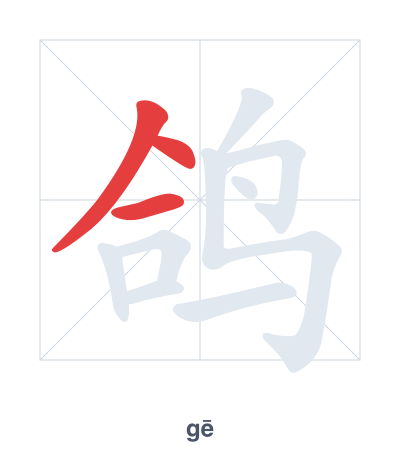
Open Hanzi Writer to see the animated stroke order and practice writing 鸽 with real-time feedback.
The character 鸽 (gē) is written with 11 strokes. Follow the standard Chinese stroke order: top to bottom, left to right, outside before inside. The radical 鸟 is one of its key components.
Practice the correct stroke order with the Hanzi Writer app to see animated stroke-by-stroke guidance with real-time feedback.
鸽 means Pigeon / Dove.
As an HSK Level 7 character, 鸽 is an intermediate-level character.
鸽 is a phono-semantic compound: 合 (hé, 'to join') hints at pigeons' tendency to pair together, and 鸟 (bird) indicates it's a bird. The 合 component also approximates the pronunciation gē.
💡 Memory Tip: Picture a dove flying with a letter sealed by a '合' sign, symbolizing how pigeons unite people by carrying messages.
广场上有许多鸽子。
guǎng chǎng shàng yǒu xǔ duō gē zi
There are many pigeons in the square.
它是和平鸽。
tā shì hé píng gē
It is a peace dove.
信鸽可以送信。
xìn gē kě yǐ sòng xìn
Carrier pigeons can deliver letters.
Open Hanzi Writer to see the animated stroke order and practice writing 鸽 with real-time feedback.
✨ Animated stroke order · Handwriting recognition · HSK-graded practice · Free to use
鸽 is composed of 合 on the left and 鸟 on the right. The left part 合 suggests "joining" or "together," and 鸟 means "bird." Together, they describe a bird used for joining people (as a messenger) or symbolizing peace.