搁 (gē) means "to put; to place; to set aside" in Chinese. It has 12 strokes with the radical 扌, and is HSK Level 7.
Rated 4.2/5 in difficulty (advanced).
Harder than 60% of HSK Level 7 characters.
Appears in 3+ common words including 搁下 (gē xià), 搁置 (gē zhì), 搁浅 (gē qiǎn).
Due to its 12 strokes, Hanzi Writer's error detection shows 搁 requires focused practice — most learners need 10+ attempts for consistent accuracy.
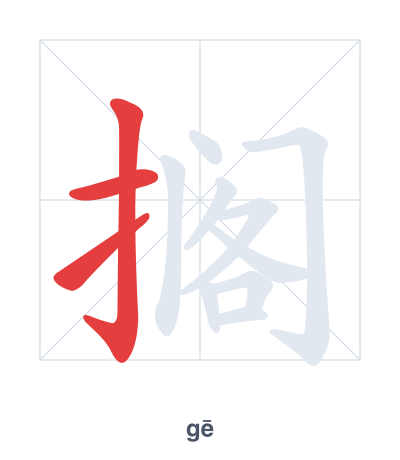
Open Hanzi Writer to see the animated stroke order and practice writing 搁 with real-time feedback.
The character 搁 (gē) is written with 12 strokes. Follow the standard Chinese stroke order: top to bottom, left to right, outside before inside. The radical 扌 is one of its key components.
Practice the correct stroke order with the Hanzi Writer app to see animated stroke-by-stroke guidance with real-time feedback.
搁 means to put; to place; to set aside.
As an HSK Level 7 character, 搁 is an intermediate-level character.
This is a phono-semantic compound. The hand radical (扌) indicates the action of placing or setting something down, while the phonetic component 阁 (gé, 'pavilion' or 'shelf') also contributes the idea of a shelf-like resting place, together meaning 'to put' or 'to set aside.'
💡 Memory Tip: Picture your hand (扌) placing a book on a high shelf inside a little pavilion (阁).
请把书包先搁下,休息一会儿再写作业。
qǐng bǎ shū bāo xiān gē xià , xiū xī yī huì er zài xiě zuò yè 。
Please put down your schoolbag first and rest for a while before doing your homework.
这个问题先搁置吧。
zhè ge wèn tí xiān gē zhì ba
Let's set this issue aside for now.
小船在岸边搁浅了。
xiǎo chuán zài àn biān gē qiǎn le
The small boat ran aground on the shore.
Open Hanzi Writer to see the animated stroke order and practice writing 搁 with real-time feedback.
✨ Animated stroke order · Handwriting recognition · HSK-graded practice · Free to use
The character 搁 combines the hand radical 扌 on the left with the phonetic component 阁 (gé), which suggests the sound. The hand radical indicates an action of the hand, so 扌 plus 阁 together mean 'to put or place something with your hand.' The 阁 part does not directly relate to the meaning but helps with pronunciation.