尴 (gān) means "awkward; embarrassed (used in 尴尬)" in Chinese. It has 13 strokes with the radical 尢, and is HSK Level 7.
Rated 4.2/5 in difficulty (advanced).
Harder than 53% of HSK Level 7 characters.
Appears in 3+ common words including 尴尬 (gān gà), 挺尴尬 (tǐng gān gà), 尴尬地笑 (gān gà dì xiào).
Due to its 13 strokes, Hanzi Writer's error detection shows 尴 requires focused practice — most learners need 10+ attempts for consistent accuracy.
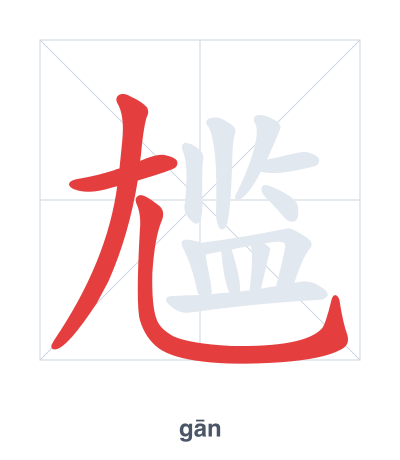
Open Hanzi Writer to see the animated stroke order and practice writing 尴 with real-time feedback.
The character 尴 (gān) is written with 13 strokes. Follow the standard Chinese stroke order: top to bottom, left to right, outside before inside. The radical 尢 is one of its key components.
Practice the correct stroke order with the Hanzi Writer app to see animated stroke-by-stroke guidance with real-time feedback.
尴 means awkward; embarrassed (used in 尴尬).
As an HSK Level 7 character, 尴 is an intermediate-level character.
The character 尴 combines the radical 尢 (a person with a physical defect or weakness) with 监 (to oversee or supervise), suggesting the awkward feeling of being watched while in a vulnerable state. This composition reflects the embarrassed, uneasy sensation captured in the word 尴尬.
💡 Memory Tip: Picture a person with a limp (尢) feeling awkward as a supervisor (监) stares at them.
那个场面很尴尬。
nà ge chǎng miàn hěn gān gà
That scene was very embarrassing.
这件事挺尴尬的。
zhè jiàn shì tǐng gān gà de
This matter is quite embarrassing.
他只能尴尬地笑。
tā zhǐ néng gān gà dì xiào
He could only laugh awkwardly.
Open Hanzi Writer to see the animated stroke order and practice writing 尴 with real-time feedback.
✨ Animated stroke order · Handwriting recognition · HSK-graded practice · Free to use
The character 尴 is made of two parts: the radical 尢 (wāng) on the left, meaning 'lame' or 'infirm,' and 监 (jiān) on the right, which gives a hint to the pronunciation. The left component suggests physical difficulty or imbalance, which connects to the feeling of being awkward or embarrassed in the word 尴尬.