尬 (gà) means "awkward; embarrassed" in Chinese. It has 7 strokes with the radical 尢, and is HSK Level 7.
Rated 3.5/5 in difficulty (challenging).
Harder than 17% of HSK Level 7 characters.
Appears in 3+ common words including 尴尬 (gān gà), 尬聊 (gà liáo), 尬舞 (gà wǔ).
Due to its 7 strokes, Hanzi Writer's error detection shows 尬 requires focused practice — most learners need 10+ attempts for consistent accuracy.
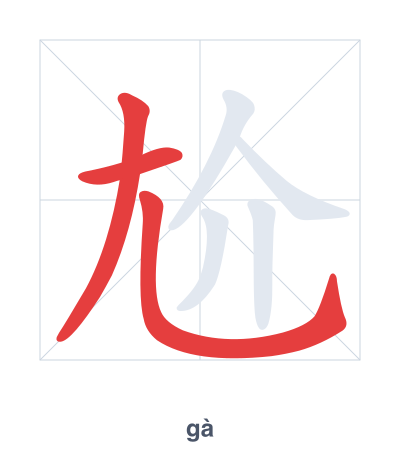
Open Hanzi Writer to see the animated stroke order and practice writing 尬 with real-time feedback.
The character 尬 (gà) is written with 7 strokes. Follow the standard Chinese stroke order: top to bottom, left to right, outside before inside. The radical 尢 is one of its key components.
Practice the correct stroke order with the Hanzi Writer app to see animated stroke-by-stroke guidance with real-time feedback.
尬 means awkward; embarrassed.
As an HSK Level 7 character, 尬 is an intermediate-level character.
尬 pairs the radical 尢 (a lame or crooked person) with 介 (to mediate or stand between), together suggesting an unbalanced or uncomfortable situation where attempts to mediate fail, leading to awkwardness.
💡 Memory Tip: Picture a person (介) with a twisted leg (尢) trying to walk straight but awkwardly stumbling—that's pure 'gà'.
我觉得很尴尬。
wǒ jué de hěn gān gà
I feel very embarrassed.
我们在尬聊。
wǒ men zài gà liáo
We are having an awkward conversation.
他们在广场尬舞。
tā men zài guǎng chǎng gà wǔ
They are awkward dancing in the square.
Open Hanzi Writer to see the animated stroke order and practice writing 尬 with real-time feedback.
✨ Animated stroke order · Handwriting recognition · HSK-graded practice · Free to use
尬 is made of the radical 尢 (lame; weak) on the left and the phonetic component 介 (jiè) on the right. The radical 尢 suggests a sense of difficulty or awkwardness, while 介 provides the sound. Together they create the meaning of feeling awkward or embarrassed.