孵 (fū) means "hatch" in Chinese. It has 14 strokes with the radical 子, and is HSK Level 7.
Rated 3.9/5 in difficulty (challenging).
Harder than 36% of HSK Level 7 characters.
Appears in 3+ common words including 孵化 (fū huà), 孵蛋 (fū dàn), 孵卵器 (fū luǎn qì).
Due to its 14 strokes, Hanzi Writer's error detection shows 孵 requires focused practice — most learners need 10+ attempts for consistent accuracy.
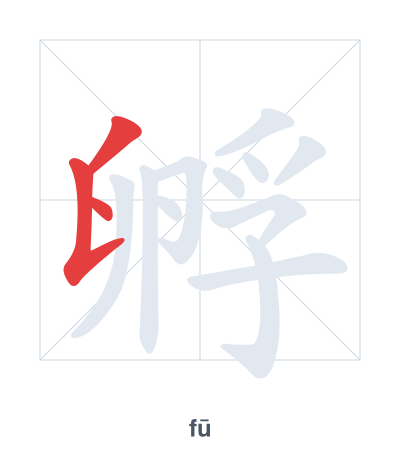
Open Hanzi Writer to see the animated stroke order and practice writing 孵 with real-time feedback.
The character 孵 (fū) is written with 14 strokes. Follow the standard Chinese stroke order: top to bottom, left to right, outside before inside. The radical 子 is one of its key components.
Practice the correct stroke order with the Hanzi Writer app to see animated stroke-by-stroke guidance with real-time feedback.
孵 means hatch.
As an HSK Level 7 character, 孵 is an intermediate-level character.
孵 is a compound character. The left part 卵 (luǎn) depicts two eggs, and the right part 孚 (fú) provides the sound while originally showing a hand (or bird's claw) covering a young, symbolizing the warmth needed for hatching. Together they represent the process of a bird incubating eggs until they hatch.
💡 Memory Tip: Picture an egg (卵) with a cozy blanket (the top of 孚) and a little chick (the bottom 子) peeping out, all warmed up to hatch.
小鸡正在孵化。
xiǎo jī zhèng zài fū huà
The chick is hatching.
母鸡在窝里孵蛋。
mǔ jī zài wō lǐ fū dàn
The hen is hatching eggs in the nest.
实验室里有孵卵器。
shí yàn shì lǐ yǒu fū luǎn qì
There is an incubator in the laboratory.
Open Hanzi Writer to see the animated stroke order and practice writing 孵 with real-time feedback.
✨ Animated stroke order · Handwriting recognition · HSK-graded practice · Free to use
孵 is composed of two parts: the left side 卵 (egg) and the right side 孚 (fu, which adds a phonetic hint for the pronunciation fū). The egg component directly connects to the idea of hatching from an egg, while 孚 provides the sound.