孱 (càn/chán) means "weak / frail" in Chinese. It has 12 strokes with the radical 子.
Rated 3.9/5 in difficulty (challenging).
Appears in 3+ common words including 孱弱 (chán ruò), 孱头 (càn tóu), 孱劣 (càn liè).
Due to its 12 strokes, Hanzi Writer's error detection shows 孱 requires focused practice — most learners need 10+ attempts for consistent accuracy.
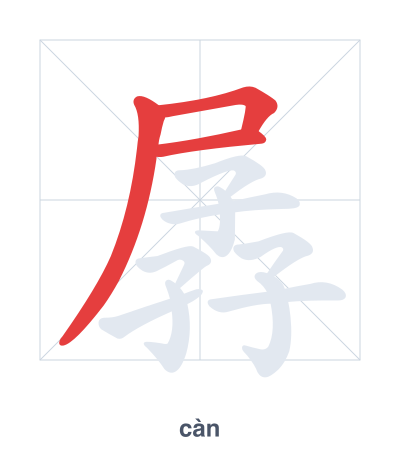
Open Hanzi Writer to see the animated stroke order and practice writing 孱 with real-time feedback.
The character 孱 (càn/chán) is written with 12 strokes. Follow the standard Chinese stroke order: top to bottom, left to right, outside before inside. The radical 子 is one of its key components.
Practice the correct stroke order with the Hanzi Writer app to see animated stroke-by-stroke guidance with real-time feedback.
孱 means weak / frail.
This is a polyphonic character with readings: càn, chán.
| Character | 孱 |
| Pinyin | càn / chán (can/chan) |
| Meaning | weak / frail |
| Strokes | 12 |
| Radical | 子 |
| Difficulty | 3.9/5 |
The character 孱 combines 尸 (corpse) above 子 (child), literally depicting a dead or corpse-like child, symbolizing extreme frailty and weakness.
💡 Memory Tip: Picture a corpse (尸) lying on top of a feeble child (子) — both are utterly weak.
他的身体很孱弱。
tā de shēn tǐ hěn chán ruò
His body is very frail.
他是个胆小的孱头。
tā shì gè dǎn xiǎo de càn tóu
He is a cowardly weakling.
这种材料很孱劣。
zhè zhǒng cái liào hěn càn liè
This material is very inferior.
Open Hanzi Writer to see the animated stroke order and practice writing 孱 with real-time feedback.
✨ Animated stroke order · Handwriting recognition · HSK-graded practice · Free to use
孱 is composed of 尸 (corpse or body) on top and 孨 (three 子 or child characters) below. This suggests a frail body that is overwhelmed or exhausted by many children, conveying weakness.