否 (fǒu/pǐ) means "no / not / to deny" in Chinese. It has 7 strokes with the radical 口, and is HSK Level 3.
Rated 3.5/5 in difficulty (challenging).
Harder than 37% of HSK Level 3 characters.
Appears in 4+ common words including 否定 (fǒu dìng), 否则 (fǒu zé), 否极泰来 (pǐ jí tài lái).
Due to its 7 strokes, Hanzi Writer's error detection shows 否 requires focused practice — most learners need 10+ attempts for consistent accuracy.
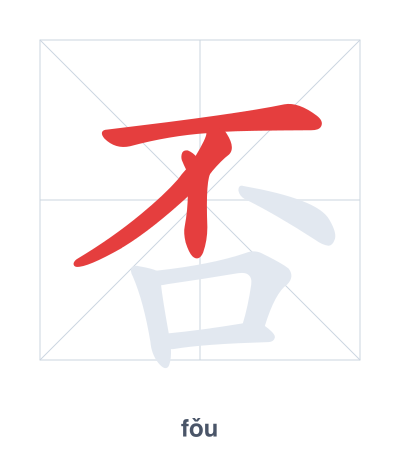
Open Hanzi Writer to see the animated stroke order and practice writing 否 with real-time feedback.
The character 否 (fǒu/pǐ) is written with 7 strokes. Follow the standard Chinese stroke order: top to bottom, left to right, outside before inside. The radical 口 is one of its key components.
Practice the correct stroke order with the Hanzi Writer app to see animated stroke-by-stroke guidance with real-time feedback.
否 means no / not / to deny.
This is a polyphonic character with readings: fǒu, pǐ.
As an HSK Level 3 character, 否 is an intermediate-level character.
否 combines 不 (no/not) above 口 (mouth), literally meaning 'saying no with the mouth' or 'to verbally deny'.
💡 Memory Tip: Imagine a mouth (口) being crossed out by a giant 'no' (不) symbol, like a hand gesturing 'stop'—that's a clear 'no'.
在事实面前,任何虚假的言论都会被否定。
zài shì shí miàn qián rèn hé xū jiǎ de yán lùn dū huì bèi fǒu dìng
In the face of facts, any false statements will be refuted.
请准时到达,否则我们将无法按时出发。
qǐng zhǔn shí dào dá fǒu zé wǒ men jiāng wú fǎ àn shí chū fā
Please arrive on time, otherwise we won't be able to leave on schedule.
现在的困难只是暂时的,相信总会否极泰来。
xiàn zài de kùn nán zhǐ shì zàn shí de xiāng xìn zǒng huì pǐ jí tài lái
The current difficulties are only temporary; believe that things will eventually turn for the better.
他为人正直,从不随意臧否他人的功过。
tā wéi rén zhèng zhí cóng bù suí yì zāng pǐ tā rén de gōng guò
He is an upright person and never casually judges the merits or faults of others.
Open Hanzi Writer to see the animated stroke order and practice writing 否 with real-time feedback.
✨ Animated stroke order · Handwriting recognition · HSK-graded practice · Free to use
否 is composed of 不 (bù, meaning "not") on top and 口 (kǒu, meaning "mouth") below. This combination suggests the idea of "the mouth saying not" or "to deny." The structure directly reflects its core meaning of negation or refusal.