Hanzi Writer

How to Write 极 (jí) — Meaning “extremely; pole”

HSK Level 3 7 strokes Radical: 木

极 (jí) means "extremely; pole" in Chinese. It has 7 strokes with the radical 木, and is HSK Level 3.

Rated 3.5/5 in difficulty (challenging).

Harder than 42% of HSK Level 3 characters.

Appears in 3+ common words including 极了 (jí le), 积极 (jī jí), 南极 (nán jí).

Due to its 7 strokes, Hanzi Writer's error detection shows 极 requires focused practice — most learners need 10+ attempts for consistent accuracy.
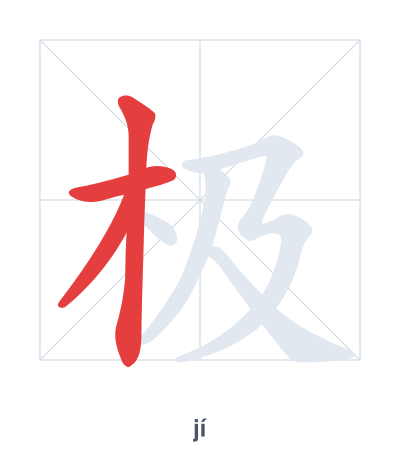
Stroke order practice for 极 - jí

Practice Writing 极 (jí)

Open Hanzi Writer to see the animated stroke order and practice writing 极 with real-time feedback.

The character (jí) is written with 7 strokes. Follow the standard Chinese stroke order: top to bottom, left to right, outside before inside. The radical is one of its key components.

Practice the correct stroke order with the Hanzi Writer app to see animated stroke-by-stroke guidance with real-time feedback.

means extremely; pole.

As an HSK Level 3 character, is an intermediate-level character.

Character
Pinyinjí (ji)
Meaningextremely; pole
Strokes7
Radical
HSK Level3
Difficulty3.5/5

极 combines the radical 木 (tree/wood) with 及 (jí, meaning 'to reach'). Originally it referred to the ridgepole of a house, the highest beam that reaches the extreme top, which later extended to mean 'extremely' or 'pole' as in the highest point.

💡 Memory Tip: Picture a tree (木) growing so tall it reaches (及) the sky—an extreme height.

jí le
extremely; very
jī jí
positive / active
nán jí
South Pole

好极了!

hǎo jí le

Excellent! / Wonderful!

他很积极。

tā hěn jī jí

He is very proactive and positive.

南极很冷。

nán jí hěn lěng

The South Pole is very cold.

Character Pinyin Strokes Radical
(current) 7
wèi 5
5
běn 5
Stroke order practice for 极 - jí

Practice Writing 极 (jí)

Open Hanzi Writer to see the animated stroke order and practice writing 极 with real-time feedback.

✨ Animated stroke order · Handwriting recognition · HSK-graded practice · Free to use

Frequently Asked Questions about 极

极 consists of the radical 木 (wood/tree) on the left and the phonetic component 及 (jí, to reach) on the right. Originally, it referred to the ridgepole of a roof, which is the highest wooden beam, so the character came to mean 'pole' (the highest point) and 'extremely'. The wood radical shows the material, while 及 suggests reaching the top.

More HSK Level 3 Characters

Characters with Radical 木

Other 7-Stroke Characters