逢 (féng) means "to meet" in Chinese. It has 10 strokes with the radical 辶, and is HSK Level 7.
Rated 4.2/5 in difficulty (advanced).
Harder than 93% of HSK Level 7 characters.
Appears in 3+ common words including 重逢 (chóng féng), 相逢 (xiāng féng), 每逢 (měi féng).
Due to its 10 strokes, Hanzi Writer's error detection shows 逢 requires focused practice — most learners need 10+ attempts for consistent accuracy.
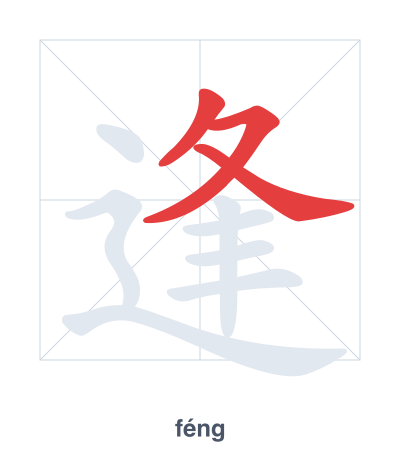
Open Hanzi Writer to see the animated stroke order and practice writing 逢 with real-time feedback.
The character 逢 (féng) is written with 10 strokes. Follow the standard Chinese stroke order: top to bottom, left to right, outside before inside. The radical 辶 is one of its key components.
Practice the correct stroke order with the Hanzi Writer app to see animated stroke-by-stroke guidance with real-time feedback.
逢 means to meet.
As an HSK Level 7 character, 逢 is an intermediate-level character.
The character 逢 is a phono-semantic compound. The radical 辶 (walk) indicates movement, while the right part 夆 (fēng) provides the sound and originally depicted two feet crossing paths, together conveying the idea of encountering someone while walking.
💡 Memory Tip: Picture yourself walking (辶) to a junction where three lines (the horizontal strokes in 夆) meet — that's where you meet your friend.
老朋友十年后重逢了。
lǎo péng yǒu shí nián hòu chóng féng le
Old friends reunited after ten years.
很高兴能和你相逢。
hěn gāo xìng néng hé nǐ xiāng féng
Very happy to meet you.
每逢过节,家里都很热闹。
měi féng guò jié jiā lǐ dōu hěn rè nào
Whenever there is a festival, the house is very lively.
Open Hanzi Writer to see the animated stroke order and practice writing 逢 with real-time feedback.
✨ Animated stroke order · Handwriting recognition · HSK-graded practice · Free to use
逢 has two main parts: 夆 on top and 辶 (the walking radical) on the bottom. The walking radical suggests movement, while 夆 originally meant "to meet" or "encounter," so together they reinforce the idea of meeting someone while moving.